Chapter Three
One Happy Family

Introduction
One Happy Family (OHF) was a Swiss NGO operating a community centre for refugees from a group of buildings halfway between the notorious Moria Refugee Camp and Mytiline - the capital of the island of Lesvos.
Although OHF moved its activities to Athens in 2022 then ceased operating altogether in November 2024, the community centre is still there and is currently operated as Parea by the British NGO - Europe Cares. The site covers about 1.5 acres or six thousand square metres and since 2017 it has been the largest volunteer run community centre for refugees in Europe.
Mytiline is a very old city with a population of around 35,000 and is the administrative home of the Northern Aegean - it has a large university and there is a young, lively atmosphere to the town. The port is busy and the road around the harbour is lined with bars and cafés with bustling shopping streets behind the water front.
A lot of the town, and the surrounding countryside, is a bit shabby and rundown with derelict buildings and old abandoned cement works and soap factories but it's still beautiful and very charming. There are lovely mountain villages and two large inland seas and the saltpans at Kalloni are regularly visited by migrating flamingos - the island is a fascinating place.
Lesvos is one of the main Greek Islands - the third largest after Crete and Evia - and is slightly bigger than Rhodes. The island faces long stretches of the Turkish coast from its North and Eastern shores and at the closest point Turkey is only seven kilometres away. Until 1912 the island was part of the Ottoman Empire so belonged to Turkey.
The small town of Molyvos (Mithymna) in the North of Lesvos, with its ancient fortress and well protected harbour was the arrival point in Europe for tens of thousands fleeing the Syrian Civil War during 2015. Estimates vary considerably but the Starfish Foundation** recorded nearly half a million arrivals altogether that year with up to 200,000 passing through Molyvos - the majority of the people being Syrian.
** I love the name The Starfish Foundation which is taken from modern interpretations of the Loren Eiseley parable - "The Star Thrower" -
After a storm, the beach is covered with dying starfish. A man sees a girl picking them up one by one and throwing them back into the sea.
“Why bother?” the man asks. “There are thousands - you can’t make a difference.”
The girl tosses another starfish into the waves. “I made a difference to that one,” she replies.
The man thought for a moment then joined her.
This little story just about sums up humanitarian work!

As the Turkish coast here is flat and well populated with a good road system there are hundreds of suitable departure points to launch the inflatable boats bound for Lesvos. The island has been one of the main access points for sea crossings by refugees from Turkey to Europe during the last ten years.
This video filmed by New York Times journalists in October 2015 gives some idea of
the situation then - as thousands fled Syria.
In the early days of the current crisis a lot of the islanders were tolerant or even supportive of the refugees.
While on Lesvos I got to know the manager of the restaurant at the Mytiline Yacht Club - his family owned a business in Molyvos and had turned it into a field hospital at their own cost during the peak of the crisis in 2015. Unfortunately, attitudes changed dramatically towards the end of 2019 as the overcrowding and strain on local infrastructure became impossible to handle.
As depicted in the video, the authorities were remarkable in how they helped the people at first. But their approach hardened over time and the Coast Guard now works closely with Frontex - the European Border and Coast Guard Agency - whose role is often more focused on deterrence than assistance.

Portuguese Maritime Police in Molyvos on New Years Eve 2018 with some of our volunteers
Although attached to FRONTEX they were known to be amongst the good guys
The UK Border Force also contributed to Frontex at the time
this cutter was photographed in Mytiline harbour in December 2018


Part of the landfill site outside Molyvos known as "the lifejacket graveyard"
Part one
The Community Centre
Twelve months after first arriving in Samos I had moved to Lesvos and joined One Happy Family. By then OHF had been operating for over a year and was firmly established and very well organised - It was as different as could be imagined from Samos Volunteers.
The coordination team was a real team with over a dozen members. Most were Swiss which, as you might expect, had a big influence on the efficiency of the group - one was Spanish and there were two Greek coordinators - Akis and Giannis.
What was most interesting and pleasing for me to discover was there were four refugees included on the management team.
Not only did One Happy Family have a large number of community volunteers they actually promoted and gave real responsibility to former camp residents. I say “former” as one of the benefits of joining the management team was they were provided with either a rented room or studio flat in the town.
One Happy Family ran many services themselves whilst also acting as an umbrella organization and providing infrastructure for several other NGOs who operated on the same site.
Another contrast to Samos was the number of volunteer groups, there were dozens of NGOs spread all around the capital area and the North of the island providing a multitude of services.
OHF managed the whole community centre site and the reception point where between fifteen hundred and three thousand people a day signed in. As part of the signing in process visitors received vouchers - OHF Drachma, our own in-house currency - which could be spent on the services we provided.
There had to be a system to ration things and this one actually worked very well.
The main services OHF managed directly were -
A coffee shop, an internet cafe, a cinema where video games could be played, a gym, volleyball and basketball, football training at Spanos near Panagiouda, a women’s space, arts and crafts, a professionally staffed nursery, supervising the children's playground, NFI distribution**, a barber shop, tailors for clothing alteration, a library and most amazing of all -
From a tiny - very basically equipped kitchen - OHF volunteers cooked from scratch and served up to one thousand simple but nutritious meals every day - promptly at one o'clock.
We had free WiFi on site and - of course - provided toilet facilities for the visitors.
** NFI = Non Food Items - soap, shampoo, toothpaste, diapers and hygiene products etc.
Our on-site partner organisations ran -
A medical clinic - by BRF - Boat Refugee Foundation of Holland.
A school - run by ISOP - the International School of Peace, a very independent Israeli/Arab NGO.
A vegetable garden - by Better Days of Greece.
Yoga Sport for Refugees of France and Greece ran a running club, boxing training and managed the yoga tent.
ReFOCUS Media labs held media training courses and helped operate a small radio studio producing podcasts.
There was even a bicycle repair and distribution service provided in the MakerSpace.
It was quite an experience to arrive and get my head around what was happening and who was doing what - it was very different to what I'd been used to.
As well as the coordinators there were usually 15-20 international volunteers and up to 50 community volunteers including our own security team. We ran two mini buses to get most of us to work in the morning and home again later - though lots of volunteers walked or cycled.
We also had our own maintenance team and a well equipped workshop with all the tools we needed.
The mainstays of this team were Faraz, an Afghan who had an incredible range of skills, and Anwar from Syria who was a very good carpenter and general builder.
It was great to see the talents of the refugees being used at all levels of the organisation and not just treated as if “we” always knew best.


Our own "currency" - which was easy to copy and
traded on a black market!


Reception area on the right
The Maker Space


Home grown produce used to prepare lunch
OHF was about four kilometres North of Mytiline on a small hill overlooking the sea with several Turkish towns clearly visible across the water.
The community centre was five hundred metres above Lidl supermarket with the original Kara Tepe Refugee Camp to the right and the then very active army firing range at Mavrovouni - a few hundred metres further North up the coast.
Our activities were often accompanied by the sound of gunfire coming from the firing range - which must have been quite disturbing for a lot of our visitors.
Part two
The Camp
Like the camp in Samos, Moria Reception and Identification Centre was originally a disused army barracks that was repurposed to house refugees in 2015. There were a few old concrete buildings and prefabs and hundreds of portacabins and isoboxes with a total capacity for about 3,000 - though by 2018 the camp was already home to 9,000 people.
The army base had been built in a shallow valley beside the road connecting Panagiouda and Larisos and was just over a kilometre’s walk from Moria village. From the village it was a further three kms to OHF and walking to the capital of Mytiline by the shortest route - which took you past OHF - was about eight kilometres.
Lidl was the nearest big supermarket and hundreds of people walked to and from there every day.
Once their asylum claim was registered residents of the camp received €90 a month allowance, credited to a prepaid card that could be used for shopping or to withdraw cash from an ATM.
Although many basic items are cheaper in Greece than the UK, €90 a month still isn’t a lot to live on.
The allowance was paid in addition to the free meals distributed by the camp authorities but the quality of food in Moria was no better than on Samos - so it was important to supplement it with something that was actually edible.
A local businessman set up a shop selling fresh fruit and vegetables and other staple foods in a warehouse next to the camp and every day there were lorries parked on the roads outside selling produce.
Inside the camp street vendors sitting cross legged sold small food items or single cigarettes and makeshift shops built from chipboard, pallets and corrugated iron appeared between the tents and buildings.
As the camp grew Afghan bakers dug small ovens in the hillside above the camp and baked really delicious naan bread.

A very simple bakery
In addition to the permanent buildings and various types of temporary structures there were huge marquees known by the manufacturer’s name as Rubb Halls - filled with cheap metal beds.
New arrivals were often kept in the Rubb Halls for weeks while being registered and waiting to be allocated tents and bedding. The transient nature of these huge communal rooms meant they became very dirty and a lot of the beds were broken and falling apart.
There weren’t enough toilets or showers for so many people and it was impossible to keep them clean as they were constantly in use. Sanitation facilities were officially the responsibility of camp management but without the involvement of the Dutch NGO - The Watershed Foundation - they would have been completely overwhelmed.
Despite the best efforts of Watershed, a lot of the toilet blocks leaked or overflowed and the stream that ran down the valley next to the camp became gradually more contaminated. By the time I was a daily visitor to the camp in 2019 it was almost raw sewerage.
High up on the hillside to the right of the main entrance there were toilet blocks that leaked and trickles of liquid ran down the road forming small streams and puddles you had to step over. The children splashed and played in these puddles as kids do - it was a miracle the camp never suffered a cholera outbreak.
As with Vathy Camp on Samos - Moria stank of rubbish and human waste.
The Watershed team did their best to maintain the facilities and built concrete wash pads in several locations within the camp so that people could handwash their clothes. But before they were used new arrivals had camped there under makeshift shelters.
Moria was a mess - even worse than Samos.

Photograph: Angelos Tzortzinis/dpa/Alamy
Tents and temporary structures had spread outside the camp fence just as they had in Vathy and living conditions varied considerably depending on which part of the camp you lived in.
The Dutch NGO - Movement on the Ground - had established an area they called The Campus which was very well organised - just to the East of the camp on a row of old terraces.
The tents in The Campus were in orderly rows with space in between and each large tent was home to ten single men. They had their own shower and toilet facilities and space for recreation and socialising. But as the camp population exploded all of the gaps between the standard Campus tents were filled with whatever shelters were issued to the new arrivals.
What had once been a well organised, almost civilised space in 2018 had, a year later, been swallowed up by the same mess of tents that had taken over all the available land outside the main camp's perimeter.


There were three special areas within the camp separated from the rest by fences topped with razor wire. All three were staffed and had securely locked gates and restricted access and there were prefabricated buildings or portacabins for their residents.
One area was the detention centre just inside the outer perimeter on the main road. This is where refugees who were arrested under the “2nd rejected” rules or other infringements were held. The conditions here were better than on Samos as the detainees were allowed outside for exercise and fresh air.
The Protected Area in the heart of the camp housed single mothers and boys on their own. Up to 120 mothers and their babies lived in one block of buildings and as mentioned briefly in chapter one - many had suffered sexual violence and very few of the women knew who the fathers of their children were.
On the other side of the same complex there were facilities for up to 200 unaccompanied minors. The definition of an unaccompanied minor being a boy aged fourteen to eighteen - though of course there were inevitably a few older boys among them.
Most of these boys had been sent by their families with friends or relatives in the hope they would get a foothold in Europe and be able to either send money home or, if possible, have the rest of their family join them later. Others simply came on their own as they had lost their families.
The third secure area was the Safe Zone located on the road up the hill to the right of the camp - just below the leaky toilets and on the other side of the same road. This Zone was dedicated to caring for unaccompanied children and had a maximum capacity of eighty - unaccompanied children are boys under fourteen and girls under eighteen.
The children on their own in this area were processed as quickly as possible and sent to the mainland into the care of social services and other child care specialists - but however efficiently they were processed there were always 60 - 80 orphans in the Safe Zone.
The Belgian NGO - Missing Children Europe - estimates that 18,000 migrant and refugee children went missing in Europe between 2018-2020 - the equivalent to nearly 17 children a day.
Most are thought to have been trafficked into forced labour, begging or prostitution.
This satellite photo shows the remains of the camp as it is today, after being burnt down in September 2020 and evacuated.
The area with the blue surround is the original army facility and the red border shows the extent of the tented area that built up around the camp.
The original camp was roughly 200 X 230 metres - which by most measures meant an extremely high population density.


Moria in the Summer
and in the Winter
After the camp was destroyed in September 2020 the residents were relocated to tents on the Mavrovouni firing range below OHF - despite the land being heavily contaminated with spent bullets.
Over the following years a completely new "provisional" camp was developed on the site of the firing range and the old Moria became the new Mavrovouni Camp - though it is often referred to as Kara Tepe 2 ** or Moria 2.0.
Mavrovouni is supposedly temporary as a new permanent facility has been under construction some 30kms further North at Vastria - though it's posible the new camp will ever be used.
Vastria was planned as a Closed Controlled Access Centre (CCAC) in a remote location of mosquito infested pine forest.
CCACs are effectively detention centres - compared by many humanitarian organisations to concentration camps, and they are the EU's latest initiative to deter refugees from coming to the islands - the idea is to keep the refugees locked up for the whole time they are being processed.
Under the old camp system the squalid conditions were deliberately allowed to fester in the hope that would put people off coming to Europe, but the conditions caused a lot of criticism and bad publicity and they still came anyway.
So now isolation and what is effectively an open prison regime is being tried to see if that stops them from coming.
The camp above Vathy on Samos was closed in September 2021 and the residents were transferred to a newly built CCAC on the site of an old slaughterhouse at Zervou about 10kms from the town.
But that didn't deter people arriving there - three years later Samos had become as popular a destination as Lesvos.
I find it quite difficult to imagine the desperation that would drive a person to spend a lot of money and risk a dangerous small boat passage to live in a prison - but despite the conditions they continue to come. The experiences of Tima Kurdi's family in Turkey do help to explain this though - I wish I had read her book years ago.
I visited Lesvos last winter (2024/25) for six weeks and it seems that Vastria CCAC, construction of which was more or less complete a year before, may never be commissioned - despite having cost the EU around €70million.
There are legal challenges as it is considered unsafe due to the risk of forest fires, the mosquitoes may make it uninhabitable and there is no proper water supply as the local desalination plant only has capacity for the towns and villages nearby - the new camp would be reliant on deliveries of water by road from the bigger desal plant 30kms away in Mytiline. With all these problems it looks as if it may remain empty for ever - despite the huge amount of money spent building it.
** The original Kara Tepe was a small well organised camp of portacabins and isoboxes housing families with young children.
Located on the other side of the coast road from OHF it was run by the local municipality and UNHCR with help from various NGOs and was built to house about 1,300 people. Anwar the OHF carpenter and his family lived there in a shared isobox.
It was closed in what appeared to be a calculated act of cruelty during the pandemic and the residents were moved to tents on the old firing range one kilometre away in April 2021.
There was another small, privately run camp near the airport called Pikpa managed by Lesvos Solidarity which used to be home to about a hundred of the most vulnerable people including disabled refugees. Pikpa was closed in October 2020 with the residents transferred to Mavrovouni.
Closure of both of these small specialised camps was widely, and quite rightly, condemned by many human rights groups.


The new camp at Mavrovouni in the first few months - winter 2020/21

Vastria nearing completion in 2023
Part three
Daily life as a volunteer
After a bewildering induction I was given my first job. Based on my previous extensive and highly professional construction experience, I was asked to insulate a tin roof and partition a small prefab building to separate a work space and create a room for our new radio studio.
I managed to source polystyrene boards and the insulation job went well but when it came to building the partition I decided to ask Faraz to help me. He watched me holding a pencil, tape measure and jigsaw as I tried to work out how to cut the first panel and started slowly shaking his head.
Gently relieving me of the tools he said “You plon - I work!” so much to my relief - that’s what we did - Faraz could make anything and fix everything and I struggled with it all.
There wasn’t a job he couldn’t do and there was no competition from me. I was grateful to concentrate on the “plonning” and watched the speed of his competence and range of his abilities in awe.
OHF was broken into one night and we were fortunate the burglars were disturbed before they emptied the shipping container where we stored kitchen supplies. The following morning Faraz cut a small hole in the steel door and created a very cunning way of padlocking the container from the inside so that even using an angle grinder you couldn’t break in again - unless you destroyed the whole door.
The following week a sliding door on one of our vans came off its runner and jammed and as I was about to drive it to the garage Faraz appeared. He whipped the door off completely and fixed it straight away - he appeared particularly adept with all types of doors - which made me feel painfully inadequate and reminded me of the lopsided door Harith and I had hung in the Alpha Centre.
It was infuriating - he could not only fix everything but played a very mean game of chess and on Sundays refereed the football matches at Spanos like a pro.

This 180mm tall chess piece, hand carved by Faraz, sits on my mantlepiece

Sunday football at Spanos
The other main man in the maintenance department was Anwar, whose skills were mostly carpentry and general construction work.
He was busy creating new classrooms for the School of Peace from the ubiquitous OSB - an inexpensive chipboard used for nearly all NGO structures. The board isn’t ideal for permanent buildings but in the environment we were working in nothing was being built to last - which was probably just as well given the events of 2020.
I fetched and carried for Faraz and Anwar as - of course - asylum seekers aren't allowed to drive.
Anwar’s wife Fatima helped to run the day nursery while their cute little girl - Islam - yes that’s a name too! - spent most of her time in the coordinators office being cuddled by Julia.


Coordinator Julia - without Islam
The day care nursery

Islam - the cutest visitor we had
(as a matter of policy we don't show pictures of children but as Islam is a teenager now this is ok)
My regular jobs became minibus driver, materials buyer for Faraz and Anwar and managing the daily opening of the NFI shop.
Lesvos and OHF were definitely my type of places so I took time out to move my sailing boat from Samos and then lived on her in the yacht marina in town.
~~~
The minibus driving involved ferrying first the international volunteers into work then making several runs to the camp to collect the community volunteers. Then taking them all home again six or seven hours later.
One of the things that impressed me most was how our helpers were punctual and always clean, smart and happy.
How they managed this living in tents without proper facilities I don’t know - but they were always well turned out and overwhelmingly positive and cheerful - despite my childish attempts to teach them the words of “the wheels on the bus go round and round” as we drove to and fro.
The NFI shop was fun too - if you’re good with crowd control.

Waiting for the NFI shop to open
The shop was run out of an old shipping container and had started on a “first come first served” basis - but somehow the same three or four women were always at the front of the queue and they always had fistfulls of OHF Drachma, despite visitors only being issued with two vouchers a day each.
The goods “on sale” were priced anywhere from two to five Drachma notes according to value or size - a small plastic bag of washing powder was two and a big bottle of shampoo five.
This small group of determined women with very sharp elbows were taking up to ten bottles of shampoo a day each. We couldn’t work out exactly what was happening, though they were obviously trading in what were supposed to be free goods - so we introduced a new system where we capped the number of customers at fifty a day.
Nicholas, one of the Swiss coordinators, was a computer wizard and designed all the systems we used and when visitors checked in with their I.D. number their attendance on site was recorded - now they could only buy goods from the NFI shop once every two weeks and had to have sufficient “money” to spend.
The new system meant 500 different people got to visit the shop every fortnight.
Even with this system we had to have helpers from the security team to keep the queue in order.
A couple of Afghan volunteers did most of the serving while I hovered around anxiously attempting to see fair play. Every week I visited Attika Human Support - an NGO warehouse collating and distributing bulk donations near Larisos, to replenish our stock.
After a few months I was asked to look after the on-site petty cash which involved reimbursing the other volunteers for purchases they made - so I was soon queuing at ATMs every morning before driving duties to keep the petty cash flowing.
We gave all our helpers a small cash allowance to top up the €90 a month credited to their cash cards by UNHCR ** and every week we gave them a food parcel, then every other week a hygiene pack. They also had free breakfast and lunch every day and use of the OHF laundry room once a fortnight - we even organised outings occasionally so being a community volunteer did feel like being part of a family.
** UNHCR stands for the United Nations High Commissioner for Refugees - a title I'm not keen on. It sounds colonial to me and conjures up a vision of some toff in a white uniform, chest covered in medals, wearing a hat adorned with plumes of feathers.
All I can picture is some bloke in fancy dress striding through refugee camps dropping coins for the children - which is probably a bit unfair as UNHCR actually does a very good and important job.
Though personally - I would still prefer the simpler title of the United Nations Refugee Agency - which is how they describe themselves.
UNRWA is another acronym they use, it stands for The United Nations Relief and Works Agency for Palestine Refugees in the Near East - which is a bit of a mouthful - they do seem to like very long titles.
Anyway - back to OHF - you might ask how we could afford everything on top of paying for the site, food, the minibus hire and rent and other allowances for some of the coordinators and helpers?
I never saw full details of the finances but the UK charity Help Refugees was a big donor and the Swiss were extremely efficient fundraisers from their base in Basel and their extensive networks in Europe. They also sold OHF merchandise including Lesvos olive oil and “safe passage” socks. I think Help Refugees was one of their main supporters though.
The charity was founded by Josie Naughton, Lliana Bird and Dawn O’Porter in 2015 shortly before the death of the two year old boy Alan Kurdi made the headlines - since 2015 they've raised and distributed over £120million worth of aid to NGOs working with refugees worldwide.
As well as being celebrities in their own right Lliana’s partner is Noel Fielding and Dawn is married to Chris O’Dowd.
Help Refugees has been generously supported by all sorts of major donors including Comic Relief and by other prominent showbiz personalities.
Anita Broderick of Body Shop was also a big supporter and she donated money and products directly to projects as well - extremely fragrant bars of Body Shop soap somehow found their way into our NFI shipping container.
Help Refugees changed their name to Choose Love in 2020.

Help Refugees paid directly for many activities but our accounts also showed turnover of half a million euros during 2017/18 - One Happy Family was quite some organisation.
~~~
One of the events sponsored by Help Refugees was during Ramadan, which in 2018 was in May - a month or so after I arrived on the island. Once a week during the holy month OHF hosted an Iftar supper for around four hundred visitors - Iftar being the meal Muslims eat to break their daytime fast at sunset.
The guests were issued tickets in the camp by another NGO and were brought by a fleet of buses to the community centre where we served a proper three course meal - starting traditionally with water and dates.
It was a big occasion held every Wednesday for four weeks and as you might expect attracted a lot of uninvited guests.
We kept the gates closed except when the buses arrived then formed a cordon of security staff to stop potential gatecrashers from joining the queue as guests disembarked - meanwhile other volunteers watched the fence for intruders. Once everyone was inside, we closed the gates again and locked them.
It sounds a bit harsh but it wasn’t possible to invite everyone and as with everything else - these suppers had to be rationed.
Our volunteers weren't authorised to enter the camp so Help Refugees arranged for the invitations to be handed out during the day by another group. They invited vulnerable families and individuals including unaccompanied minors living outside the Protected Area - though inevitably some were missed.
I was allocated to security duty for the first supper with Giannis, one of our Greek coordinators, and we sat just inside the gate after the buses left watching the stragglers who weren't invited drift away.
A few minutes after it went quiet a man walked up the hill with three young boys - the biggest boy was about eight years old and the smallest was probably four and the little one wore crocs - one green and one pink and both to fit left feet. All of them - including the father - were a bit scruffy.
I guess they had come from Kara Tepe, the camp for vulnerable families across the main road and judging by the state of their clothes, especially the odd shoes - the children's mother wasn't with the family. I wondered how on earth a man copes on his own in a camp with three little boys without their mother? It was beyond me and obviously I felt very sorry for them.
After a bit of persuasion Giannis agreed to check and see if there were four empty places for the supper and we let them in when no one was looking.
Giannis was the younger of our two Greek coordinators and was sometimes a bit hasty for my liking.
A few months later it was his decision to sack the Iraqi man I mentioned in chapter one - the father who needed to use the laundry every couple of days because of his daughter’s incontinence.
Giannis was the only coordinator, or volunteer for that matter, with OHF who seemed to enjoy exercising his authority. I always felt rather uncomfortable with the automatic seniority having a passport gave us over the refugees.
The other Greek coordinator Akis was in his forties and was much more laid back and experienced than Giannis - and it wasn't long before we were working closely together.

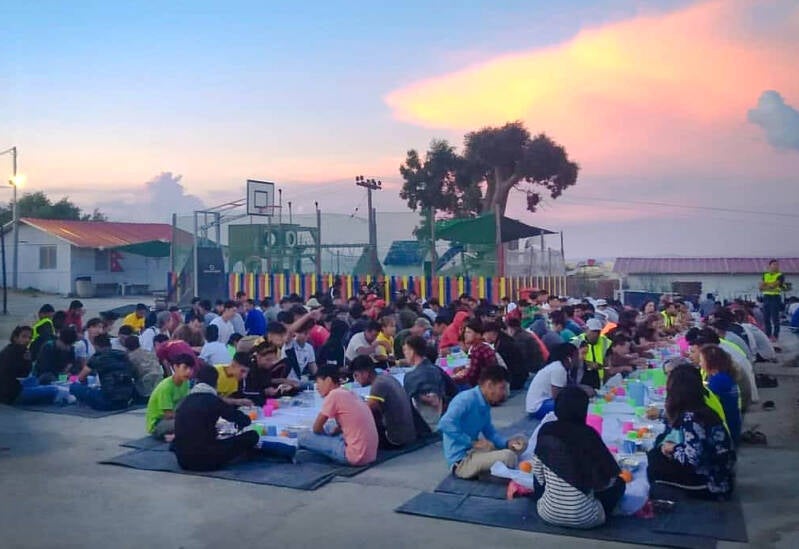
Getting ready for the big party
Sunset
the building on the left was the BRF Clinic next to the children's playground
One day Akis told us an interesting story about the early days of the community centre -
OHF was located on the side of a hill and accessed by a narrow road leading away from Lidl to the small industrial area opposite our site.
The road ended just above OHF but when the centre opened the short cut over the hill from the camp was established by people walking there from Moria.
They also walked up from Lidl and Kara Tepe so there were two approaches to OHF from opposite directions - one for all types of traffic and one just for people on foot.
Prior to OHF opening the only vehicles on the road were staff and visitors for the industrial area and it was unusual for anyone to walk there at all. Now there were hundreds of walkers, cyclists, minibuses and full size coaches clogging up the road every day.
The School of Peace at OHF taught English and Greek to adults in the mornings and provided schooling for about 200 children every afternoon - and they were all bussed in on coaches from the camp.
This narrow steep road with a bad bend at the bottom of the hill had become a very busy route solely because of OHF.
As with most rural areas on the islands there were houses scattered randomly everywhere and they all had big gardens with grape vines and orange and olive trees. Most of these households also kept poultry and other livestock and it was quite common for people to have their own goats - and there were several smallholdings like this on the road leading to OHF.
Following the establishment of the camp and the community centre there were suddenly hundreds of poverty stricken and malnourished people passing these houses every day.
The owner of one of the houses came to the coordinators office one morning carrying a heavy black bin bag which he emptied at Akis’ feet. The bag contained the severed heads of four of his goats which he'd found in his garden - all that was left of his animals.
The man was very angry and demanded compensation - before OHF opened no one ever used his road or knew his house was there and now he'd not only lost his goats but had to invest in security for his property.
Before the refugee crisis it was normal for the locals to leave their houses unlocked and this type of theft had simply not existed.
Though to be fair to the refugees - given the desperate circumstances they lived in and the callous way they were treated - they were remarkably well behaved and this type of incident was extremely rare.
Another less serious but more frequent problem was the theft of pallets - as well as smallholdings there were industrial units and warehouses lining the local roads and it wasn't unusual to see a refugee dragging a pallet towards Moria to put under his tent.
Sales of razor wire rose and guard dogs appeared in the yards of warehouses and factories in attempts to prevent this.
Of course - if conditions in Moria Camp had been more humane and the food at least edible these kinds of theft may not have happened at all. In my experience the vast majority of refugees were honest, decent people - but it's hard to stay honest when your life is hopeless and you're broke, hungry, cold and wet.
As the refugee population grew and conditions in the camp deteriorated, petty crime was becoming more of a problem and the locals were slowly starting to get fed up with the increasing number of asylum seekers on their island - and by the management of the situation by the Government in Athens.

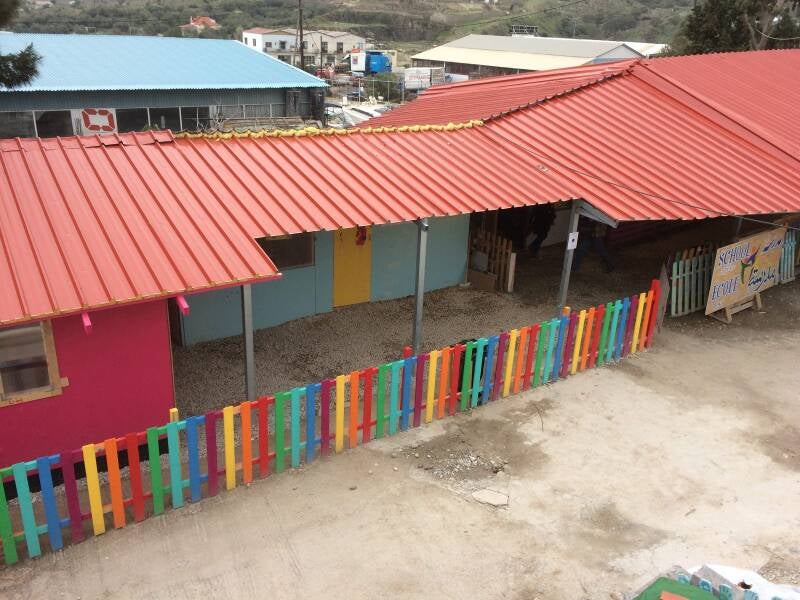
Our beautiful school
Not long after arriving at OHF I bumped into an old friend from Samos - Hassan The Potter.
Hassan was a Syrian refugee who is a very talented artist. His speciality is moulding clay heads in the style of the ancient Romans - but I think he can turn his hand to anything - a couple of years ago he sent me a lovely wooden carving of a ballerina.
After being rejected in Samos the authorities had transferred him to Lesvos which was quite unusual - I never heard of any other asylum seekers moved from island to island like this.
We’ve stayed in touch and he is now in Germany, though doesn’t seem to be very happy there and dreams of a life in Canada.
His sister has been living in a camp in Lebanon for ten years and is also very talented. Last year she painted a family portrait of me with my daughters from a photo Hassan sent her.
It’s a shame to see such clever people having their lives ruined by war and a system that treats them with such indifference.
There are so many good people whose lives are going to waste.


A group of visitors came to OHF with donation funds and asked what they could buy for us and we soon had a small room with an electric kiln for firing pottery
So for a while - Hassan was happy sharing his skills teaching others
Part four
From pottery to pots and pans
or
How to feed a thousand people a day?
To be honest - I’ve no idea how it was done - but it was.
And every day, five days a week - and as I said earlier - the food was served at 1.00 on the dot.
There was no GMT - Greek Maybe Time - the kitchen ran as smoothly as a Swiss watch - all prepared, cooked and served from a room three and a half metres long and two and a half metres wide.
Like most of the team I helped out when it was time to serve the lunch - but the main people behind this daily miracle were OHF’s first female refugee coordinator Sifiso - better known as Fifie, who is from Zimbabwe - and Mohammed, a Rohingya muslim known simply as "Burma".
Every morning they peeled, sliced and chopped (and opened a few very big tins) then cooked away in some huge cauldrons over gas burners for an hour or two. They were usually assisted by a couple of volunteers - though it took quite a few more of us to serve the food and clear away afterwards.
A thousand servings is a lot of food, plates and disposable cutlery - and a lot of washing up too!


Fifie
Haniye - who gets the photo slot as she's prettier than Burma!
The members of the kitchen team varied from time to time but during most of 2018 the cooking was managed by two women and one man, all refugees who had lived in the camp - Fifie, Burma and Haniye.
They were helped by community and international volunteers but these guys did most of the work - from menu planning to ordering, stock control and preparation to delivering the final product - which was excellent.
This was all part of the OHF philosophy of using all the talents available and engaging as many asylum seekers as possible in everything we did.
Refugees are not all children - the grown ups are adults and need to be treated as such.

Okay he gets a photo after all - Burma - they couldn't have done it without you
There is a big political issue in the UK at the moment over asylum seekers which has become increasingly emotive.
One of the biggest and very genuine concerns is the cost of housing them while they are processed - which is seen by many for what it is - a system that wastes a huge amount of taxpayers' money.
Registered asylum seekers in the UK are either housed in bulk accommodation such as former hotels or dispersed into inexpensive rented flats or houses (HMOs).
They are given a weekly payment credited to an ASPEN card (Asylum Support Enablement Card) and in bulk accommodation where they are fed they receive £9.95 a week - if in self catering they currently receive £49.18 per person per week.
They are not legally allowed to work, though most of them would like to and of the rest they want to continue their education. I deal with these people all the time and have never met one who wants to sit on his backside all day and live off the state - they all want to work and contribute and most are very uncomfortable being kept inactive and in limbo.
My personal view is that if allowed to work they would cost us less to look after and it should be possible to devise a fair system whereby their efforts to integrate are taken into account when deciding whether or not they can stay. Of course this shouldn't override the humanitarian aspect of their application - but most of the people I know want to start working and leading normal lives and would welcome such a system.
As over 80% of registered asylum seekers are eventually given the right to remain in the UK they might as well start making a positive contribution as soon as they can.
At the former hotels - which I visit regularly - the management structure is like this -
The building is managed by its owners - usually a large hotel chain who find it more lucrative to lease the property to a Home Office contractor than to continue running it as a hotel.
(Bear in mind that since the pandemic, the rise of Airbnb and with increased use of video calling - demand for hotel rooms in non tourist areas has collapsed. The properties I visit won't reopen as hotels - they just aren’t viable any more and when their present contracts end they will be sold or redeveloped.)
The Home Office appoints housing contractors for each region of the UK - companies like Clearsprings, Serco, etc. - and they are responsible for managing the asylum seekers themselves and overseeing the day-to-day running of the site. They reimburse the property owners for running costs, generally manage the contract and decide who lives where.
In the former hotels meals are cooked, cleaning is carried out and laundry is done by paid staff - surely it would be better for the asylum seekers to do this work for themselves?
If we followed the model used by NGOs working in Greece residents would be given responsibility in return for payment.
In the UK hotels minimum wage could be paid (after deductions for housing and food costs) to suitable residents for doing this work. This would save taxpayers money, reinforce the work ethic we expect from new arrivals in the UK and give idle hands something to do.
It would also give the people the self respect they want - sitting around all day while someone else hoovers round your feet, changes your bed and does your laundry is not good for anyone. **
The money saved could be spent on professional staff to work on language skills, integration, job seeking and training advice - all of which are completely absent at the moment.
We need a much more progressive and intelligent approach to how we deal with asylum seekers - the British Government and Home Office could learn a lot from One Happy Family.
** There are lots of stories about how they get free clothes, iPads etc. and these are not true - anything above basic needs (including English classes) is provided by charities - though there is a lot wasted on travel costs, taxis etc. which I think is ridiculous on all levels.
The issue of how to stop people coming is above my pay grade - but whilst war and conflict create refugees and global inequality drives economic migration the number of people on the move will continue to increase - and these are the fundamental issues we need to address.
In the meantime we need to improve how we deal with those already here.
Part five
Time for a new venture?
Life with OHF was extremely busy - but at least I didn’t have friends being locked up in prison all the time as happened on Samos - thankfully prison visiting wasn't part of my daily routine any more.
I was still going home every 6/8 weeks to check on my business and was covering my travel costs by renting my home in Shropshire for holiday lets while I was away.
For most of the year I could live on my boat in the Mytiline Marina and was enjoying the lifestyle and the work on Lesvos.
I saw Jonathan from Samos regularly and Majida visited with her now full time boss Dr. Manos to see what the situation was like in Moria. Samos had been getting busier with many new arrivals and the camp at Vathy was in chaos - construction of the new CCAC outside the town at Zervou was nearing completion and expected to open soon.
Many more NGOs had set up on Samos in the year since I left and a small group of us led by Fanny Oppler, a founder and board member of OHF from Switzerland, visited the island in early 2019 to see if we could help.
It was a good trip but we concluded Samos was well covered and we should concentrate on Lesvos - though the visit was still worthwhile as we learnt so much from the other groups working there. Obviously, I was interested to see how the MSF funded and Samos Volunteer managed laundry had worked out as the project would have been my responsibility if I’d stayed on Samos - and we had been discussing doing something similar to support scabies treatment in Moria.
When we got back to Lesvos we decided to push forward with our own medical laundry.
At the time there was nothing similar on the island and apart from domestic laundry being done for volunteers, as we did in OHF - there was little effective capacity to support either individual clothes washing or medical treatment in the camps.
Though of course - no discussion of laundry facilities for refugees on Lesvos is complete without mentioning one of the most famous volunteer groups of the day - The Dirty Girls of Lesvos - run by the wonderful and eccentric Australian - Alison Terry-Evans.
The Dirty Girls had been operating since 2015 though their service was very different to the type we had in mind - they were effectively a new or refurbished blanket distribution service.
As tents were abandoned or people in fixed accommodation were transferred to the mainland Alison and her team collected the blankets they left behind and had them professionally cleaned and sterilised by a commercial laundry on the North of the island.
They also bought or had donated new blankets and distributed both new and properly cleaned blankets to either new arrivals or those who just needed more bedding - which was a big demand ahead of the winter.
Our plan was to take the laundry of families or individuals and return it to them clean and folded the following day - and it had to be washed and dried at a high temperature. We did end up doing some bulk items - especially during the pandemic - but most of our work was for individual customers.
We talked to MSF about replicating the operation on Samos - but from discussions with their logistics manager it appeared that while they were keen to collaborate with a medical laundry - they didn't have the budget to fund one.
They ran their regional operations from different European headquarters and each island had its own management structure, financial strategy and policies - MSF Lesvos didn't have money for us - so we made an appointment with the local representative of Help Refugees.
After several meetings they agreed to help with initial finance - it's always easier to get donations when a project is up and running and getting started is definitely the hardest part - but at this point we had no idea where all the money would eventually come from.
To start with we bought one washer and dryer of the type we planned to use to try out in our own laundry room and recorded cycle times and energy consumption to help with feasibility planning - but there wasn't enough space at OHF for the size of operation we had in mind.
The facility we wanted would need three phase electrical supply and mains drainage which was virtually impossible to install at OHF - and we also wanted to be closer to the camp - so Akis and I started looking for suitable premises.
Twelve months after arriving on Lesvos I was on my way to setting up a new and much needed NGO to support the thousands of scabies sufferers in Moria camp.
Some random (but lovely) photos from OHF


Got any holidays planned?
Alem from Afghanistan - head of security
Happy kids in happy playground

Team OHF


OHF olive oil Crazy coordinator Majd Xman


Islam - being spoilt as usual
(but not by Julia)
Islam's parents
Anwar and Fatima


The OHF gym
My favourite volunteer - the FLTO
(Funny Little Turkish One)

OHF from the air - the red roofs on the right are The School of Peace