Chapter Five
The Mayhem of 2020
~for everyone - the local people - the refugees - and the volunteers~
Introduction
We received a large private donation over Xmas 2019 and by February had finally equipped the laundry as fully as we could with ten washing machines and twelve dryers - ten electric plus the two gas dryers we used for heat treatment to kill scabies, bed bugs and viruses - and later Covid 19 which is killed in five minutes at sixty five Celsius.
We had even bought our own small car for running non camp errands - like collecting lunch everyday for our volunteers and helpers from the One Happy Family kitchen.
The ten washing machines we had were two robust heavy duty ones that were reliable - but took up a lot of space - and eight semi commercial ones that having been used for ten hours a day for six months - were starting to show signs of wear.
One or two were always down for repairs but by now we could usually manage around 70 batches (about a tonne) of laundry a day.
We started the new year in good shape - we were extremely busy but had a great team of international and community volunteers - systems that worked well (we hardly ever lost a sock) and the most amazing collaboration from a dozen partner organisations.
Unfortunately the overall situation on the island was getting worse as the number of new arrivals continued to rise and transfers to the mainland had slowed almost to a standstill.
The camp management, local government, police and coast guard were all overwhelmed and the physical facilities were crumbling - by the end of February the estimated number of refugees on the island was thought to be around 21,000.
The population of Mytiline is 35,000 and the whole island is 80,000 and 20,000 people were living in squalor in cabins and tents a few kilometers from the edge of the small capital city.
Moria was rammed and increasingly chaotic and all the NGOs were working flat out - the volunteer groups were doing their best to plug as many of the gaps as possible - but something had to give.
The refugees in the camp were desperate and the locals were exasperated - and the people on both sides had begun taking matters into their own hands.
Part one
The violence begins
It’s hard to remember now the precise order of events but the atmosphere was getting more aggressive almost every day - petty crime was on the rise and in response the residents of Moria had stopped the refugees walking through their village.
Local people were manning blockades at each end of the village and there was always a police car on duty to observe what happened - the protesters refused to let refugees pass their homes so the refugees turned back and took different routes.
The villagers had oil drums they lit fires in every night and they worked a shift system to man the blockades 24 hours a day.
There was increasing dislike of NGOs and volunteers for supporting the camp - some of the locals thought we encouraged the refugees to come and were making money out of what we did - which was really not true.
The Greek employees working for NGOs earned less than they would in a normal job, for international volunteers who got paid it was a small allowance - barely enough to cover their cost of being there.
Because of the change in mood we had stopped driving through the village a long time ago - the streets are very narrow and there is a one way system and if we got held up one or two of the locals had started shouting at us or banging on the side of the van - and plenty of others gave us hostile looks.
Walking through the blockade in the morning from the house I'd rented in the village was ok - but coming home in the dark was not. By eight or nine o’clock the villagers were cooking over their braziers and drinking ouzo or wine and were more confident and aggressive.
One night towards the end of January I was walking home with Snowy and we had passed the group around their blazing oil drums by about a hundred metres when I heard footsteps running up the hill behind us.
Two young men holding beer cans were trying to catch up with us and I expected the worst. One of them put his hand out for me to take and I hesitated but then thought that was pointless - there were two of them so whether I had both hands free wouldn’t really help - I was never much of a fighter and I was holding Snowy's lead with the other hand anyway.
As it turned out they wanted to apologise for the way we were being shouted out and intimidated - they didn’t want the refugees in their village but disapproved of the abuse and aggression shown towards us as we passed the blockade.
It’s amazing what a difference having a white face and a cute little dog can make to your life - they were really quite ashamed and apologetic about the treatment we were getting.
~~~
Jonathan from Watershed had lived in the village for over a year and once or twice a week we met up at Litza's bar on the main street for ouzo and a bite to eat. The bar was tiny and only patronised by locals, who all seemed friendly enough and they made a big fuss of Snowy - the area around Mytiline wasn't very touristy and I doubt a casual visitor would ever be attracted to the place.
Litza’s husband was a policeman so everyone knew to behave themselves - though that didn't stop a local man trying to ride his horse into the bar one night just before Xmas - it didn’t work out though and he only got the horse's head through the door - the doorway was far too small for a fully grown horse. Litza's was definitely the best bar in the village.
There were several empty premises on the main street that had been rented by NGOs for offices or activities and as well as the R4R shop next to the laundry there was another clothing distribution site between the village and the camp.
Quite a few groups also rented houses in and around the village for their volunteers and support for the camp had been contributing to the local economy - but the negative impact of twenty thousand refugees living a kilometre away was now clearly seen as outweighing the benefits.
A week after the encounter with the two guys from the blockade I was sitting in Litza’s with Snowy when a group of young men ran past wearing motorcycle helmets and carrying clubs and baseball bats. They didn’t see me or try to come into the bar but started smashing the windows of the shops the NGOs were renting nearby.
They then attacked several of the volunteer houses while the occupants hid inside - and smashed the windows of any vehicles parked outside. The next day volunteers started moving away or leaving the island and I decided I’d had enough and would go back to the boat, even though it was out of the water in the boatyard.
I moved out the next day, losing a deposit and some rent I'd paid in advance, as I was too scared to stay in the village any longer. Jonathan of course stayed put - he'd been there for so long he was known and accepted by the locals and he never seemed to be scared by much.
The locals would probably have considered him a special case anyway as they knew how important the work he did in the camp was - the last thing they wanted was a cholera outbreak on their doorstep.
(The problem with writing this story on a website is that it never actually gets finished as there's always new information coming in - Jonathan now tells me he was just as frightened as everyone else but was reluctant to give up the house in the village that had become his home!)

Jonathan Turner of Watershed in his DIY converted camper
It was about this time that the trouble started in Vastria - where the government was beginning to build the new camp with all the EU money they'd been given.
They had chosen the remote inland site for the CCAC (Closed Controlled Access Centre) to be as far from both Mytiline and the tourist areas of the North coast as possible.
The authorities had issued compulsory purchase orders for some of the land but not all of it was registered - even though it had been owned by families for generations. Fencing was being erected around the site without everyone being paid for their land - so it was blockade time again.
This time boulders and old vehicles were placed across the dirt road to the site and when the contractors tried to move the obstacles the locals fought back - the police got involved and there was a stand off.
Civil protests against the camp were also taking place in Mytiline
This photo of a demonstration in mid February was published by Al Jazeera in March 2020

Thousands of Lesbos residents protested last month against overcrowded migrant camps on the island
[Elias Marcou/Reuters]
As well as the riots taking place inside the camp refugees marched on the town in protest and were met by local police in riot gear - one of the medical volunteers from our partners, Boat Refugee Foundation, who was there to give first aid assistance, was arrested by the police but released a few hours later.
A lot of the refugee protesters were injured or arrested and the march was stopped outside the town near Kara Tepe - the protesters eventually dispersed after being teargassed.


Heading for the city
Halted outside Kara Tepe
Part two
The violence escalates - riot police are sent to Lesvos
Work on the CCAC at Vastria was at a standstill, locals were blocking the access road and the contractors couldn’t get to their site so Athens decided to take decisive action - it was almost as if they had said
“How dare these islanders defy us!” - they appear to have decided to teach them a lesson.
They chartered a ferry to bring reinforcements to Lesvos - a new consignment of heavy bulldozers and equipment would be sent accompanied by a contingent of five hundred MAT.
MAT is the acronym for the Monades Apokatastasis Taksis - also known as The Units for the Reinstatement of Order who are a heavily armed division of the Greek Police specialising in riot control.
The plan was to send the ferry with its AIS (Automatic Identification System) switched off and have it arrive unannounced in Mytiline port in the early hours of the 26th of February.
Athens seemed to underestimate the strength of feeling of the islanders who of course knew exactly who was coming and when - the people of Lesvos turned out in force to meet the representatives of their government.


MAT disembarking the ferry

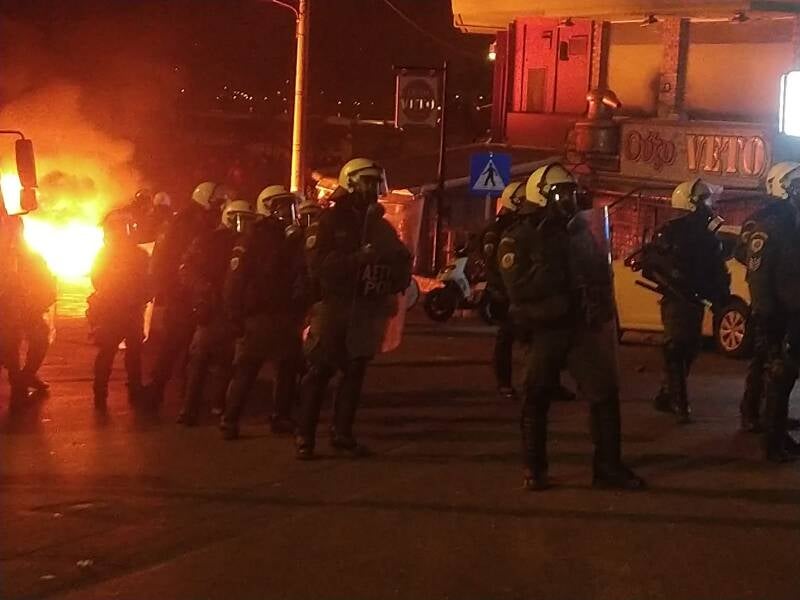
Locals gather outside the port and street fighting begins
Tear gas was used once again but this time it was directed against the islanders as they threw molotov cocktails, bricks and cobble stones at the riot police - apparently the MAT hurled insults back as well as tear gas calling the locals “Turkish seeds” as they fought each other in the streets.
A friend and colleague - Doug Herman of ReFocus Media Labs was there to record events but told us later “I was cold cocked by a guy my dad's age and didn’t see a thing.”
Some of the MAT were followed to their accommodation and attacked in their living quarters - several were seriously hurt including reports of two being injured by gunfire - apparently they were shot in the legs in their dormitories.
Athens realised they had misjudged the situation and the riot police were withdrawn from the island 48 hours after they arrived.
Meanwhile - back at the camp - the approach road from Panagiouda was being blocked to prevent the new arrival buses getting through - although other vehicles were allowed to pass.
Any cars or vans that obviously belonged to NGOs were having abuse hurled at them. We were still allowed through but it was quite intimidating and we were being photographed - obviously we took The Lava Project stickers off the van and had no signage at our premises.
The following headline and the photo and text below were published by "Keep talking Greece" on the 1st of March 2020
East Lesvos to set up road blocks to enforce “border” to West Lesvos

"Local authorities on the island of Lesvos have decided to set up road blocks and enforce a “border” between the West and the East parts of the island.
The decision was taken at an emergency meeting on Sunday, after more than 400 migrants and refugees arrived on the island from the Turkish coast.
According to the unprecedented decision, those refugees and migrants arriving at the Municipality of West Lesvos will also stay there and will not be allowed to cross into the East part.
Present at the meeting was the Regional Governor of the North Aegean Region, Costas Moutzouris, New Democracy member and former Justice Minister, Charalambos Athanasiou (he had the idea that the new migration center is built on inhabited islet), the Mayor of Mytiline and the communal president of Moria.
At the meeting, it was decided that the Municipality of the island’s capital Mytiline “is closing its border with the Municipality of West Lesvos so that migrants arriving there do not reach Moria,” locals newspaper Lesvosnews reports.
When buses of the Greek Coast Guard transferred the new arrivals to Moria, the local authorities had called the residents to set up blocks. And so they did.
With an emergency request to the government in Athens, Mayor of West Lesvos, Taxiarchis Verros, asked two ships to be sent to the island as soon as possible (with the same speed as the riot police was deployed last week) in order to relocated asylum seekers to the mainland and ease the deadlock."
This meant that one approach road to the camp was blocked by the West Lesvos authorities and the other by demonstrators.
The government sent a huge military landing craft to the island and it moored alongside in Mytiline harbour and the newly arrived refugees who could no longer be taken to the camp were stored in the vessel until it was overflowing with people two weeks later - they were then taken to the mainland. Naturally there were no proper facilities on or near this landing craft which rapidly became home to about 500 men, women and children.
Where new arrivals were taken to first depended on where they had landed and there was a small temporary detention centre on the North of the island that some were taken to for initial processing - this camp was attacked by arsonists and burnt to the ground to prevent it being used.
Riots, assaults and disturbances were becoming more common in and around the camp and we had to call off visits when we thought it wasn’t safe.
Our helper Khalid asked to be locked in the laundry one night as he thought it was too dangerous to go home to his tent.

A lone woman defies the police
In late February we had a visit from the mayor of the village and two of the organisers of the blockades - the mayor was elderly and small but the other two were big well built men and were very intimidating.
Our landlord, who knew them all, joined the discussion and we explained that most of our work was medical laundry for MSF (we thought it was better not to mention helping the hundreds of teenage boys) and if we had to close it could result in more pressure on the local hospitals and clinics.
They appeared to accept that we provided an essential service and didn't apply pressure to stop us operating - and a week later we were the only NGO left in the mayor's jurisdiction.
Several volunteer groups had stopped work as the trouble grew and those who tried to keep operating were visited and told there would be consequences if they didn't close straight away - about ten days after R4R left their shop the premises suffered an arson attack.
One of the changes we decided to make after the visit was to stop letting volunteers shelter in the laundry overnight.
Part three
The situation deteriorates
It was during this period the Turkish authorities effectively turned on the migration tap.
There had been heavy fighting in the Idlib Province of Syria since late 2019 and for two months Syrian government forces with Russian air support had been attacking towns and cities in the region where roughly three million people were trapped.
As well as conventional artillery, cluster and barrel bombs were used and there were hundreds of civilian casualties and thousands displaced - close to a million people had started heading for the Turkish border.
Trying to prevent this the Turkish military had clashed with the Syrians and Russians, they had suffered heavy losses and now wanted EU assistance urgently.
As part of Ankara's strategy to pressurise Brussels - on the 27th of February Turkey announced it would no longer try to stop refugees from leaving their territory and crossing into the EU.
Thousands of refugees gathered at border crossing points and there were reports (denied) of the Turkish government actually bussing refugees to the land borders and coastal areas as part of the pressure they were applying on the EU.
It was also reported Turkish forces tried to help migrants break through a border fence with an armored car - the Greek police apparently repelled the refugees with the help of local citizens armed with fire extinguishers and clubs.
Rumours also circulated that the police and other government authorities were encouraging the people smuggling gangs to send more boats to the Aegean Islands (also denied by Turkey).
Whether the smugglers were actually encouraged or not the decision to no longer prevent crossings caused an unprecedented number of vessels heading for Greece - one convoy of half a dozen rubber dinghies even left during daylight which was highly unusual - crossings had always been single boats at night as they were harder to detect.
The fact that refugee boats were now crossing in daylight made it easier to see what the Coast Guard and Frontex were doing to deter them - and they were out in force for the daytime crossings.
There had always been cases of refouling (forcible return of refugees boats to Turkish waters) but it was difficult to report on as it usually happened at night.
Refoulement is illegal under international law, even if people are being sent back to Turkey. The same principles apply in UK waters - once someone is within a country’s jurisdiction they have the right to claim asylum there - and forcibly returning them to France without allowing that claim and without their consent is unlawful.
The accounts from the refugees themselves spoke of being rammed, washed by a larger vessel passing close in front of them at speed or blocked and boarded and having their outboard motors disabled. Also physical attacks and beating by men wearing dark clothes or black dry suits with their faces covered.
They said it was common for the refugees’ rucksacks and possessions to be thrown overboard - especially their phones.
There were also reports that the drivers of the boats had their fingers or hands broken - usually the driver was a refugee who had some sort of boat handling experience, or just claimed he had as they got a discount on the cost of the trip.
After boarding, the refugee boat was then towed back to Turkish waters where it was left to drift - usually the Turkish coastguard were notified of the position of the abandoned boat and sometimes the Frontex vessel waited until the people were rescued.
There is no suggestion that the vessels of all countries took part in refoulement or that it was official Frontex policy - the captain of each vessel would have to participate willingly as endangering the small boats would be a violation of maritime law. Most reports suggested it was the Greek Coast Guard who were particularly involved in this conduct.
This video was apparently recorded near Bodrum but we were told by the refugees that this type of action was commonplace - and from recent witness accounts it is still happening now.
Whilst it’s not difficult to understand the attraction of wearing a uniform, especially one that lets you boss other people around or play with expensive government owned toys - or preferably both - it does take a special type of screwed up sadist to attack unarmed women and children miles from the shore in a fragile rubber boat.
Take a side politically, that's fine, dislike foreigners if you want to - I don’t agree with you but that’s up to you - but to deliberately try to destabilise already unseaworthy and overcrowded boats or shoot at them - that’s definitely crossing a line.
~~~
This equally shocking video was posted recently on Facebook and shows a rubber dinghy containing men, women and children being repeatedly rammed by a Greek Coastguard vessel - this action is totally illegal. Apparently this occurred in November 2025.
~~~
Back to February/March 2020 - early one morning at the small town of Thermi just North of Panagiouda a rubber boat with about 30 people - all families with most of the occupants women and children - was towed into the harbour with a broken engine and local people gathered to stop them getting ashore.
The stand-off lasted all day with the boat drifting in the harbour while the townspeople pushed it away from the quayside with wooden poles. Several police stood by but didn’t interfere and a German journalist Michael Trammer was attacked and injured for trying to film what was happening.

His attack was also filmed here (age restricted) https://www.youtube.com/watch?v=Hk3v8sRDcik
It was very sunny and quite warm for a winter's day so the locals threw bottles of water to the boat for the children - then at sunset they gave in and let them ashore to be taken into custody by the police.

Keep Talking Greece reported -
"Things got out of control in the port of Thermi on the island of Lesvos on Sunday, with locals to block migrants and refugees to disembark from dinghy with a broken engine. Not only did the locals used vulgar expressions and threats against the desperate people, they also attacked two local city counselors, journalists and photo-reporters and the head of the local UNHCR office."
On March 1st there was another attack on volunteers when an Irish doctor on her way to work in the camp was in one of five cars attacked by a mob of men on motorbikes, who smashed the car windows with planks and baseball bats.
Dr. Nicola Cochrane told the Irish Times
“These Greek men and teenage boys in balaclavas carrying big sticks, planks of wood and baseball bats started smashing our windows. They were shouting at us to get out of the cars, I was worried they were going to start grabbing us. I don’t know what they would have done if we had stopped and got out. All our cars were smashed to pieces.”

The Lava Project also made its own small announcement on social media on the 27th of February
"Due to the events and unrest of the last few days we are sorry to announce that The Lava Project will be closed for the rest of the week until Tuesday 3rd of March when we hope to open again.
Lesvos is on fire. The local population is exhausted, the people in the camps are exhausted and we, as aid workers, are exhausted too. This situation has reached its limits.
We stand in solidarity with the people of Lesvos especially the small villages and communities whose daily lives have been so badly affected as well as the residents in the unsanitary hell hole that Moria camp has become. This number of refugees on Lesvos and the horrendous conditions in the camps is completely unsustainable and unacceptable.
No more overcrowded camps, no more violence, no more inhumane treatments. Immediate transfer of asylum seekers and refugees to the mainland and other European countries.
The Greek Islands need an urgent solution that takes into account the human rights of everyone. Greece can’t deal with it alone. Europe wake up, take action and responsibility!"
We reopened the laundry as planned on the 3rd of March and did our best to resume something like a normal service. With the mayor’s approval to continue and no indication the situation was getting worse, we felt it would be safe to carry on as long as we were careful.
We were joined by two new international volunteers - Nick, a Brit living in Spain and Rachel from the USA. They could both drive our van and the car and were planning to stay for at least a couple of months and I was booked for one of my regular visits home for two weeks on Saturday the 7th of March - Anastasia, Nick and Rachel would manage the project while I was away.
There was a large apartment above the laundry that we'd recently rented for our international volunteers, if things got lively outside they could stay on the premises until the trouble subsided again. In the unlikely event of an arson attack the apartment was safer than the laundry as it had very secure access, a large roof terrace and being concrete the building wouldn't burn - anyone locked in the laundry during an attack could easily be asphyxiated but everyone agreed the apartment should be safe.
In addition to the events described above there had been more individual acts of violence as far right agitators came to Lesvos to join the fun and games. Some members of Golden Dawn, a neo-nazi political party whose leaders were given long prison sentences later that year, had come to town and several prominent far right thugs flew in from Germany.
The Germans were quickly identified by local members of Antifa who beat some of them up and they left soon afterwards - but the Golden Dawn boys managed another rampage through Moria village before being forced to leave as well.

Right wing troublemakers on their holidays
Mario Muller and Johannes Scharf, both Identitarians or with strong links to the Identitarian movement
Photos courtesy of Leil-Zahra Mortada via Barba Midilli and No borders on Twitter
Identitarians - ideological movement centred on the preservation of white European identity
I recognised two of the other Germans as I checked in for my flight on the Saturday evening and sent a message in our volunteer WhatsApp group to inform friends they were leaving - and an OHF colleague messaged back to suggest I sit near them to find out where they were going next. Some of the Germans had been reported heading to the land border crossing points and she wanted to be able to warn colleagues there.
Now - this wasn’t an entirely practical suggestion as I don’t speak German but I did agree to follow them in Athens airport to see if they were flying on or staying in the city. That seemed quite an easy bit of sleuthing - the choices were International or National departures or the taxi rank - what could possibly go wrong?
Unfortunately they were a bit thick (or perhaps had too many drinks before leaving Lesvos?) and kept getting lost inside the airport and having to turn back the way they’d come. The first time I kept walking but the second, third and fourth times they got lost I had to hide behind a pillar or pretend to study a magazine rack - eventually they found their way to the taxi rank so I made my report and headed for my flight home.
While I was in Athens airport, messing about playing Inspector Clouseau - arsonists climbed over the fence into OHF setting fire to the main building and burning down the beautiful School of Peace.
Here are some photos of the damage caused by the fire.
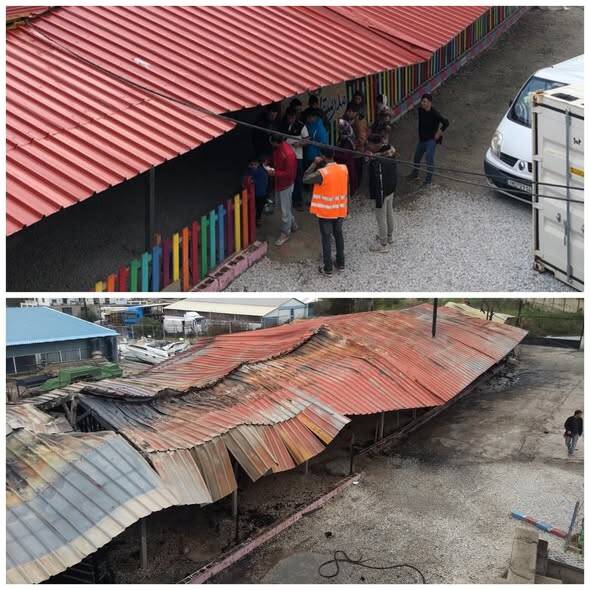

The school before and after
and after and before
You can see the supporting frames and roof survived though very badly damaged but the timber (OSB) walls burnt away completely.
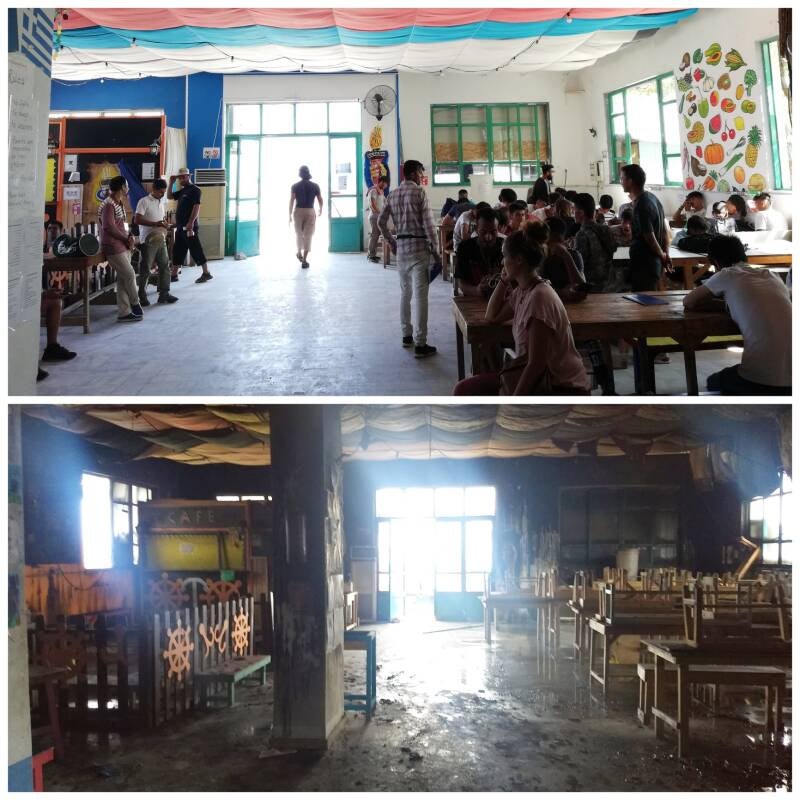
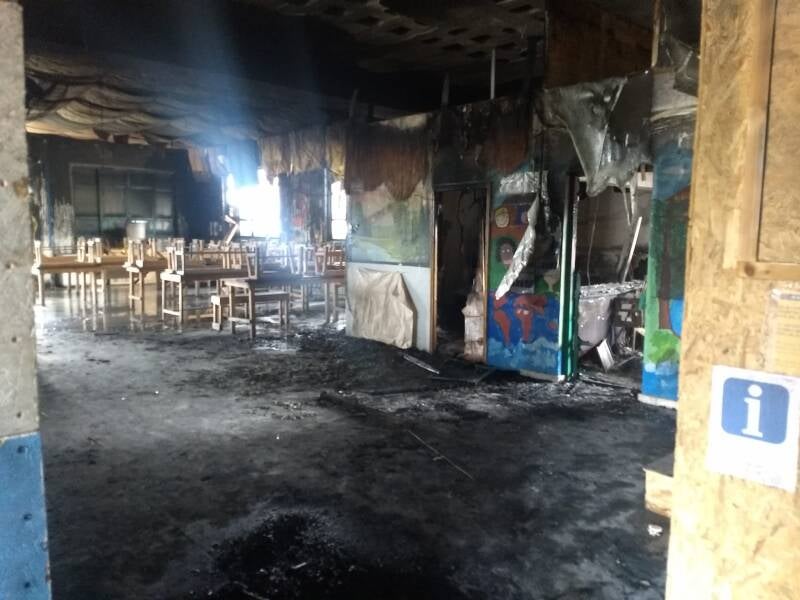
The main hall before and after
More of the main hall

The wreckage of the school being removed
Police forensic investigations confirmed it was arson but the culprits have never been identified or arrested.
Most of the events described so far in this chapter, especially the street battle in the early hours of the 26th of February, would normally have made international news - but the whole world was transfixed by how to deal with Covid.
Part four
March 2020 onwards
I arrived home on the 8th of March and on the 11th the World Health Organisation declared the global pandemic - then on the 16th of March Imperial College London published a report forecasting a quarter of a million deaths in the UK unless strong preventative measures were taken.
The Government advice that followed was to avoid non-essential contact, work from home if possible and avoid pubs, clubs and theatres etc.
The last part of this announcement was a problem for me as my business comprised one wine bar and one pub restaurant - suddenly our slowly declining business was stone dead.
Four days after the avoid pubs announcement we were ordered to close and the country was locked down completely three days later.
Obviously it was impossible for me to return to Lesvos.
During February a young lawyer from Thessaloniki had agreed to buy the boat but hadn’t placed a deposit so that was a problem too and I assumed the sale would fall through.
The only good news in all this was that the team at The Lava Project would continue working as well as they could. Anastasia lived in Mytiline and wasn’t going anywhere and Nick and Rachel were stuck in the apartment upstairs and couldn’t get home even if they wanted to.
So I worked on salvaging my business and kept an eye on the laundry as best I could from Shropshire.
On 12th March MSF had issued an appeal to depopulate the camps and make a plan for Covid but it was ignored
https://www.msf.org/urgent-evacuation-squalid-camps-greece-needed-over-covid-19-fears
While the pandemic was tightening its grip on the UK life - or rather death - continued as normal in Moria.
On the 17th of March One Happy Family posted this on Facebook
"We are devastated - we are in shock.
Yesterday, a huge fire broke out in RIC Moria, which caused the loss of a 6-year old girl and the destruction of shelters for almost 200 people. We lack of words, to describe our grief and anger about this tragedy. But we fully support the statement of Stephan Oberreit (MSF Greece) who says "European and Greek authorities who continue to contain people in such inhumane conditions have a responsibility in the repetition of these dramatic episodes. How many times we have to see the tragic consequences of this inhuman policy of containment before we urgently evacuate people out of the hell of Moria.”
(https://www.theguardian.com/.../child-killed-in-lesbos...)
Today, instead of evacuating the enormously overcrowded camps on the Aegean Islands, the Ministry of Migration announced, that they will put the camps on lockdown. People will be forced to stay within the camp with nowhere to go. In a camp, which described as one of the worst refugee camps in the world. In a camp where basic human rights are not granted, where humanitarian standards are not even close to be met and where the physical and psychological well being, the safety and security of everyone is in danger.
We don't want to think about what is going to happen tomorrow."


Some photos from the Moria fire of March 2020 - credit Refocus Media
The laundry closed again on 24th of March and reopened a few weeks later - partly to resume medical laundry but also to support the efforts of refugees from the camp who were producing thousands of reusable face masks.
The masks all needed to be washed and sterilised and The Lava Project had just the kit for that.


Nick Gardner and Rachel Sweren
Homemade face masks
Nick had moved to Spain from the UK in 1975 and was now a retired local government researcher and active environmentalist. He contacted us to volunteer at the end of 2019 and left home to travel by rail and sea on the 17th of February - Covid was on the horizon as he set off but wasn’t threatening enough to deter him from joining us.
He arrived in Mytiline for a two month stint with The Lava Project on the 21st of February but was soon trapped on the island by Covid - his two months became five and he eventually left for Spain at the end of June.
Rachel was from Baltimore and had originally planned to join us in early March before I left, but because of the rising violence and vigilante activity we agreed she would delay her travel by at least a week - in the end she arrived in Mytiline just after I went home.
She also got trapped by the pandemic and stayed with the project for nearly eighteen months altogether.

Anastasia, Rachel and Nick between them kept TLP running for the first half of 2020 and on June 26th they celebrated the first anniversary of the project with this social media post -
“This past week, we celebrated our first anniversary as The Lava Project!
Our weekly statistics board usually records our laundry-related accomplishments, but we make sure to keep track of the sentimental ones too! Here are some of the most noteworthy:
13,875 bags of cleaned laundry
4,000+ individual scabies patients
60,050 articles of cleaned COVID-19 personal protection equipment
8 community volunteers
5 international volunteers
6 languages spoken while working (English, Greek, Somali, Dari, Arabic, and French!)
3 puppies inaugurated into the Lava family
1,500 trips to Moria camp
74 (very) late evening shifts worked by Ross
624 cups of Greek coffee consumed on the job (mostly by Anastasia)
22 power outages during peak business hours
15 plates of homemade sweets made by Nadifo
86 dance parties in the back”
I think the dance parties were mainly Rachel, Nadifo and Dega
By coincidence we received a birthday present from the Rotary Club of Twickenham who sent us a very welcome donation in June.
In early July travel restrictions in the UK were lifted and businesses like mine were reopening - and I also received an email from the lawyer in Thessaloniki -
“When shall we meet to complete my purchase of the boat?”
By this time I was very keen to sell - to put it mildly - and started booking flights immediately.
The flight from Athens to Lesvos was straight forward enough but no sooner had I booked UK to Athens than I was notified the flight was cancelled and I was trying again. After two days messing around like this I threw some clothes and a sleeping bag in the back of the car and set off to take a ferry from Dover to France.
The following night I was in Modena in Italy and the next morning drove to Ancona to book the ferry to Greece - but that was sold out as it was the first ship to carry passenger traffic across the Adriatic since March. So I bought a ticket for the next sailing and after a 24 hour delay was bound for Igoumenitsa.
The whole journey was crazy - in the UK we were following strict distancing rules but no one in Europe seemed to care and the restaurant on the ferry was packed with lorry drivers clustered together talking very loudly and spraying their germs all over each other - with not a face mask in sight.
I left the car at Athens airport and arrived in Lesvos six days after leaving home - completed the sale of the boat and watched with great relief as the lawyer and his friends sailed out of the harbour a week later. I've always had a lot of luck - which has mostly been bad - but just for once it was good.
I tried to follow quarantine regulations as far as it was practical and didn’t visit the laundry during the first week and when I did was amazed to see how normally it was working. Anastasia and the team were well - Nick who had worked some very long weeks and days for five months left just before I arrived back on the island and Anastasia and Rachel had everything under control.
It was great to see the guys again but the atmosphere was noticeably different - everyone was very subdued and while the buildings at OHF were being rebuilt they had no visitors. They had repaired most of the fire damage but were still waiting for permission from the authorities to reopen.
Fearing yet another change in the rules that might prevent me getting back to the UK I set off home again as soon as I could - I would much prefer to have stayed on Lesvos but the survival of my business took priority now.
I was back in dear old Blighty again before the end of the month - by which time our businesses had been allowed to reopen.


Dega platting Rachel's hair
Help - let me out!
Nadifo - who was our first community helper
Ok - let's take a short break from the events on Lesvos to consider life in pandemic Britain - which was something of a contrast to helping refugees.
It was now my full time job trying to understand the bewildering and constantly changing regulations being dreamt up by Boris Johnson and his colleagues - particularly as they applied to pubs and restaurants.
I’ve had to do some research to remind myself what they were:-
First set of rules - No bar service, one metre distancing, customer details to be recorded and try to get everyone to sit outside (assuming you had an outside?).
Then - Dishi Rishi introduced "Eat Out to Help Out" - so we went from discouraging customers to being closed - to being open but still discouraging customers - to giving a government subsidy of £10 to tempt people to come out for a meal.
This was followed by something totally incomprehensible called - “The Rule of Six” (which sounded like a naughty book to me) - this meant that if two families of four came for dinner they had to sit at adjacent tables and shout at each other.
And then - face masks when standing but not when seated, table service only, mandatory test and trace and closing at 10pm.
We really struggled to understand how to give our customers their usual jolly social experience - who wants to go out to be ordered around all night?
Then we were shut down again for a month and when we reopened we had a new set of rules - one of which was if you wanted to go out for a drink you had to have a substantial meal to go with it (paid for in full without Dishi Rishi chipping in a tenner).
During this phase of the pandemic a journalist asked Michael, now Lord, Gove (the one who looks like Rick Moranis) - who was at the time The Chancellor of the Duchy of Lancaster - to define what a “substantial meal” actually was.
The Chancellor of ...... whatever - explained that although he was a “trencherman” himself a scotch egg could be considered to fall within the legal definition of a "substantial meal". Whether or not this was ever passed into law is unclear - but suddenly we were all looking up recipes for scotch eggs.
Except one local pub who bought the cheapest they could find from the cash and carry and sold them as an accessory to a pint for a pound - most of their customers left them in the plastic wrapping next to their beer or gave them to their dog.
I had a bite of one of these “scotch eggs” and it tasted of sawdust - I didn't think it was good enough for my own dog so left the remains on the table. (I had adopted a rescue dog called Bushi in August.)
I don’t underestimate the seriousness of the pandemic or the terrible losses that happened as a result - but the antics and ever changing rules imposed by our politicians were as baffling as their verbal contortions attempting to explain them all - and the scientists at the evening press conferences often looked as confused as we were.
Also - prior to The Scotch Egg Saga - I had never realised we had a government position called “The Chancellor of the Duchy of Lancaster” - and was beginning to wonder what century we were living in.
~~~
Once more back to the camp - where conditions in Moria had gone from bad to worse.
Incredibly, the first case of Covid wasn't recorded at Moria RIC until the 2nd of September when a Somali man who had recently been discharged from hospital was diagnosed - and full restrictions were immediately imposed to quarantine the camp.
As over half the residents lived outside the camp perimeter police roadblocks were set up on all the possible routes in or out.
Tensions grew and violence quickly flared up leading to a full scale riot which started on the 8th of September - the fires set by the rioters burned down the whole camp during the course of the night.
Thousands became homeless immediately and the police prevented them from leaving the area - without food or shelter they were trapped on the roads outside the remains of the refugee camp.


Once again these events went largely unreported - the pandemic still dominated and we had a few more months to go before mass vaccinations got under way.
This video is worth a watch -
Moria camp burns as far-right rises in Lesvos
