Chapter Four
The Lava Project

Introduction
In April 2019 we decided to go ahead with a medical laundry to support residents of the infamous Moria refugee camp. At the time the camp was thought to have around 12,000 residents - nearly 40% of them were children and the medical clinics estimated that half the population were infected with scabies.
A commercial scale laundry needs a few basic things -
Lots of water at high pressure, a good and reliable electrical supply (in our case and for the number of machines we planned it would have to be three-phase), waste water disposal and heat extraction.
Very simple really -
Clean water in - dirty water out
Power in - heat, dust and fumes out
We were aiming to kill scabies mites and eggs and they either have to be deprived of their food source (their human host) for three or four days or be exposed to over fifty degrees centigrade for ten minutes.
Scabies mites are too small to see with the naked eye but basically they burrow under your skin - eating you as they go - and leave behind their faeces and eggs. Once you start to scratch skin infections develop which can cause impetigo and in some rare cases more serious issues such as kidney and heart disease.
The scratching gets the mites or eggs under your nails and helps it to spread - flakes of skin also get into your clothes and bedding. So in addition to medication - everything the patient wears or sleeps in has to be treated.
Scabies won't usually spread from one person to another by brief contact such as shaking hands but does spread easily if sharing bedding or clothes - or just living in a very confined space with an infected person. It can also spread during sex and is often found in or around the genitals - the mites crawl very slowly and have a typical speed of 2-3 millimetres a minute outside the body and when burrowing under the surface layer of skin progress is usually 2-3 millimetres a day. In a newly infected person it can take several weeks for the body's immune system to cause a visible rash and for itching to start.
The most severe form of the disease, known as crusted or Norwegian scabies, occurs in densely populated and unhygienic conditions where malnutrition weakens the immune system. It was widespread in some Syrian prisons but fortunately - no cases that severe were reported in Moria.
This recent Guardian article explains in more detail about scabies in the UK
https://www.theguardian.com/science/2026/jan/18/the-sudden-rise-of-scabies?
We also hoped to kill bed bugs which were a big problem in the camp - they’re harder to kill and a slightly higher temperature of sixty degrees or more is needed.


A scabies mite
what scabies looks like
as few as ten mites could cause this
and here's a bed bug

From a jolly Lava Project Facebook post
Part one
Finance and logistics
Help Refugees agreed to provide initial financial support but were quite clear on one issue that would determine where we could operate.
They didn’t mind where the laundry was located but were fed up with paying bills for emptying waste water or septic tanks - mains drainage was only found in the larger towns and most out of town properties relied on tanks.
We were planning on at least ten 12kg washing machines (a European domestic machine is usually 7 to 9kgs) and if we were going to use each machine ten times a day we would generate at least six tonnes of dirty water every day - which could cost €3/400 a week to empty.
So whatever else we did - we had to find a site with mains drainage.
We were really lucky and found a suitable vacant warehouse with drainage midway between Moria village and the coast road for €500 a month - we could set up The Lava Project about four kilometres by road from Moria Camp or two kms on foot - the premises were perfect.
The landlord made it a condition of the lease that people couldn't bring their own laundry to the building - anti refugee sentiment was growing and with literally thousands of people walking through the tiny village of Moria every day he didn't want to upset his neighbours. This was fine with us because - as usual - we were going to need a very strict allocation or rationing system and didn't want people queuing outside.
We also anticipated we would collect and deliver back the clean laundry - usually the next day - and it would be easier to control everything if we could set the timetable for that ourselves.
We had to establish the NGO and have it registered, open a bank account, arrange utilities etc. and as my language skills were only sufficient to order a jug of wine we needed a Greek person to help us (I had once apologised to a man for not speaking Greek and he said "Of course you speak Greek - you just don't know you do!") and we would need a lawyer.
After a thorough search and exhaustive recruitment and selection process we appointed Anastasia - Akis’ partner - to the role of local coordinator and we found a really excellent lawyer in Mytiline - Dimitra Chatzileonida. I'm not usually one for recommending lawyers but Dimitra was great.
As well as handling all our local formalities Anastasia was hands on in the laundry and drove the van for collections and deliveries to the camp - I remember when we went together for the first time she was stunned to see the number of children there were.
Next steps were preparing the building -
The first thing we did was build a toilet and shower room - if we were going to recruit community helpers this would be essential. You can’t expect someone to work in a hot laundry all day then queue for two or three hours for a shower when they get back to their tent. I also need to use a toilet occasionally and prefer it to be clean!
With the camp population at around 12,000 the number of people per shower or toilet was around a hundred, so having a clean bathroom and being able to eat breakfast and lunch onsite made it possible to cut out most daily queuing and work a seven hour shift - having decent food would be a bonus too.
In the first month some visiting volunteers from another group very kindly paid for a fridge, microwave and other kitchen equipment - the generosity of individuals was amazing and we were making really good progress.


Faraz getting started - while I was busy with the "plonning"
We were fortunate to have the advice and support of Jonathan Turner who was operations manager with The Watershed Foundation - the NGO looking after most of the plumbing and sanitation infrastructure in the camp.
We ordered a 6000lt water tank and pump to make sure we had enough water pressure if all the machines were running at once and this also covered us for supply interruptions, which for some reason were quite frequent. The flow from the mains was so weak the tank actually took several hours to refill after a busy day’s work.
We bought shelves, racking and office equipment, rented a minibus with the seats removed and our wonderful electrician - Panagiotis Adamidis - started work on cable trays and wiring.
Panagiotis was the electricians union president for the island so knew everybody in the industry - which was more than useful - he was a miracle worker.
Before we could install our three-phase boards the village substation had to be upgraded and he managed to get this done in weeks rather than the usual months (or years). The project moved forward really quickly thanks to Panagiotis and the skills of the rest of the team.
On the 26th of June 2019 we washed our first clothes.
By our first anniversary - which was three months into the pandemic - we had washed over 13,000 bags of laundry - roughly 180 tonnes of clothes and bedding including over 60,000 hand made face masks.


Faraz tiling the shower room
Water tank delivery
Connecting the new electrical supply
We started the laundry with just two sets of machines because of the initial power limitations - and we also ran out of money almost straight away.
The situation on all the islands was deteriorating rapidly as more new arrivals landed and facilities and services were under severe strain everywhere.
Help Refugees agreed to continue making a monthly contribution to our running costs but couldn’t finance the purchase of any more new equipment - they just had too many commitments elsewhere.
So in the first few weeks we struggled to achieve 20 large bags of laundry a day.


Panagiotis at work
Faraz's daughter playing hide and seek
Cleaner than in the camp
We set up a crowdfunder on GoFundMe which over the next two years raised over £23,000 - GoFundMe were great, they actually donated £500 themselves - and we were very fortunate to have sponsorship from other organisations for specific bills. I even made a donation myself - from the beginning to the end of my volunteering I never took any payment or contribution to my own costs and often bought small items without claiming expenses - but this time I put some proper money in.
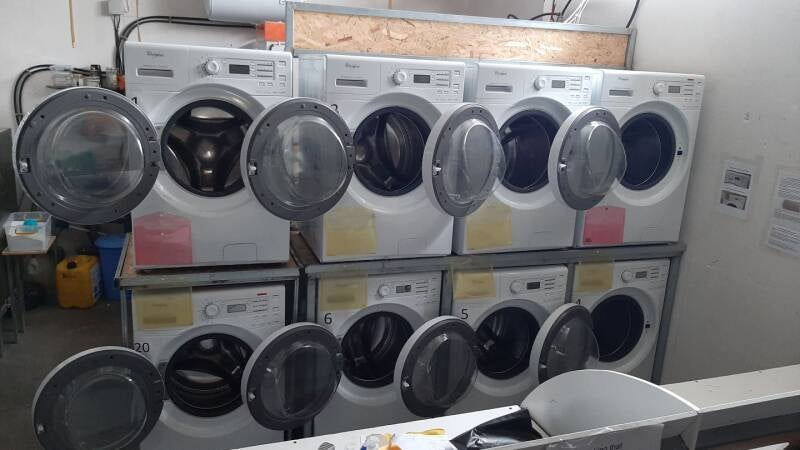
Together for Better Days had some machines they couldn't use so they gave them to us - and the UK charity Hope and Aid Direct brought a commercial washing machine and gas drier from England on one of their aid convoys.
Help Refugees donated monthly, Mission Lifeline of Dresden paid for our electricity and after some negotiation MSF agreed to pay a set amount per wash for their patients - somehow we scraped by.


June 2019
August - More machines please!
November 2019

A day's laundry

Gas dryer delivery from the UK
Part two
Scabies Treatment
The gas driers were a very important part of the process for scabies laundry - our standard procedure was to wash everything at sixty celsius which took an hour - each batch was then dried in an electric machine which took another hour and once dry it was transferred to one of our two gas driers for heat treatment at seventy degrees for ten minutes.
This made sure scabies and bed bugs and almost anything else would be killed and all laundry, whether from scabies patients or not was treated this way.
Occasionally we were given mattresses too big to wash so we heat treated them - they might not have been cleaned but at least we killed whatever they were infested with.
After the second gas drier was delivered we installed a bulk gas tank in the garden at the rear of the premises.
The treatment of scabies patients involved four groups working together - the clinic referring the infected people and providing their medication, which for families was MSF, R4R (Refugee4Refugees) who supplied clean clothes for them to wear until we returned their own sterilised clothes, the Dutch NGO Shower Power, who took the patients to their premises to get clean and apply the treatment cream and The Lava Project.
The system with MSF was they would select the patients for treatment on Day 1 and by 5pm they sent us and R4R a list with their names, gender and approximate clothing size.
R4R whose free clothing shop was thirty metres down the road from us, selected clothes for all the patients which they delivered to us the following morning before 8.30.
So on Day 2 we took the clean clothes - individually bagged and labelled - to the MSF clinic opposite the camp main entrance to rendezvous with the patients - this was supposed to happen at 9am GMT - Greek Maybe Time.
The patients were all families and MSF - who had a stock of our bin bags and labels - had already instructed the patients to put clothes and bedding in separate bags.
The bags we gave them were the right size for our machines’ capacity but some people swapped them for larger ones and there were nearly always issues and delays while we sorted the bags out.
Each person was limited to one bag of clothes - if they had more clothes they could put those in another sealed bag for four days and the scabies would die of hunger. Bedding, as it's bulkier, wasn’t limited.
With luck we would be back at the laundry for 10am with a van full of washing all correctly labelled - though some days this took much longer. On one memorable occasion a Mr. Popalzai arrived with his family and at least a dozen massive bags of washing - he alone brought enough work to occupy us for most of the day - these huge bags contained at least 40 batches of laundry.
He must have brought all his neighbours' things as well as his own family's and it took an hour just to sort him out before we could get on with our work.
Whenever we got bombed like this again it was referred to as "A Popalzai Event" - they really made a mess of the rest of our day.
As soon as we got back to the laundry priority was given to the bedding we'd been given by the MSF patients - these had to be processed straight away as we had to return them for 7.00 o'clock otherwise people would have nothing to sleep in - any significant delays put us under a lot of pressure.
The patients were given the medicated cream and their bags of new clothes and were taken by minibus to Shower Power’s premises where they would take a hot shower, have help to apply their cream and put on the clean clothes we'd given them.
Shower Power gave them lunch as well and entertained the children - so being treated for scabies was actually a nice day out for the family - almost anything was better than a day in the camp!
After their shower they placed the clothes they’d been wearing into the same bags the clean clothes came in, sealed them up and starved the scabies to death for four days - before wearing them again.
For MSF - and us - to explain all this in multiple languages was quite a task and misunderstandings happened all the time.
At 7pm we met the patients outside the camp and returned their bedding - their washed and heat treated clothes were given back to them the following day (Day 3) at midday - GMT.
This rolling program gave us time to wash and dry everything and we often worked till 9.00 o'clock at night to get everything through the machines.
The 7.00 o'clock bedding delivery could easily get quite silly as they all appeared in their clean but often bizarre and ill-fitting temporary clothes.
The more fashion conscious refugees made quite a fuss and we tried to have a laugh and joke with them, pointing out how amazing they looked and explaining it was only for one night and they mustn't put their own clothes back on yet - which for some reason they often tried to - some of them did look very funny though.

A seven o'clock delivery
All visits to the camp were fraught but at least when we collected from MSF we were able to drive into their compound and conduct business without drawing a crowd.
When we delivered the bedding in the evening the clinic was closed so the clean laundry was handed out on a piece of waste ground near the camp entrance - and a van handing out stuff soon attracted onlookers who thought there might be something in it for them.
One of our helpers was a young Afghan man named Raheem - he had been a refugee most of his life and spoke several languages so he always came with us to translate and keep the crowds calm. We had a great team but Raheem was definitely the most useful for the camp visits we made several times a day.
Raheem’s own story went like this -
During the Afghan civil war which followed the Russian departure in 1989, his father's life was in danger - so the family left their home in 1997 when Raheem was three and crossed into Pakistan where they lived in a refugee camp for years.
By the time Raheem was fifteen the Americans and their Nato allies had been in Afghanistan for over ten years and his father decided to visit their home town to see if it was safe to return but was killed by the Taliban - so the rest of the family decided to stay in Pakistan.
Raheem went to work in a travel ticketing office and a few years later he met and fell in love with a young local girl - Sahira.
Afghans often face hostility and discrimination in Pakistan and when Sahira’s family discovered the relationship they threatened to kill them both. So Raheem and Sahira ran away together, made their way across Iran and for a while tried to create a life for themselves in Turkey - where they had two children.
Unable to obtain residency or work legally - by 2018 they had joined the refugee trail to Europe and were living in a tent in Moria with their kids.
The family eventually made it to France (with a bit of financial help from a German volunteer) but Raheem suffered very poor physical and mental health and he and his wife were both attacked by a Pakistani guy who disapproved of their “mixed” marriage.
They’ve had a very tough time but are slowly getting their lives on track in Montpelier - where I met them again a couple of years ago.

Slowly getting there - 6 months after starting
Raheem teaching English to his neighbours' children


Anastasia with two of our
Somali helpers - Nadifo and Deqa
Our new garden ornament
held two weeks gas supply

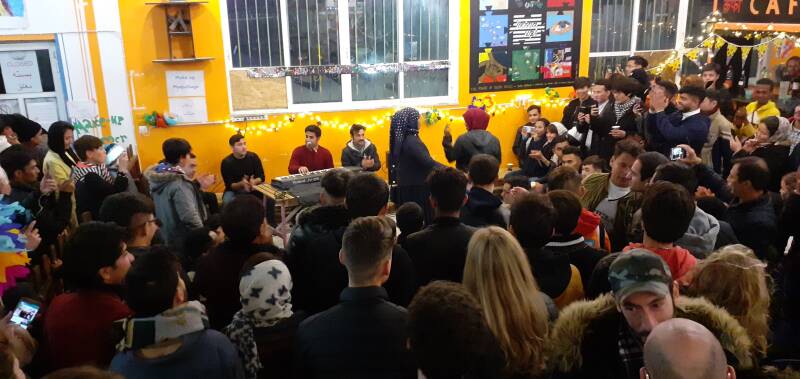
Team Laundry OHF New Year Party 2019
The Party in full swing
Part three
Working with a strange American religious sect
As well as the medical work we were also washing for the single mothers and unaccompanied minors in the Protected Area. We took the towels and bedding for the children in the Safe Zone but that was a relatively small job as the children were encouraged to wash their clothes themselves.
An American based NGO Help International - which is part of the Mormon Latter Day Saints (LDS) Church of Utah - had a large team of volunteers working with the unaccompanied minors and whilst they couldn’t help us with money - they offered to give us their time.
As most of the camp admin staff worked Monday to Friday the boys in the Protected Area would have had less support over the weekend - so Help International covered Saturday and Sunday in the camp and took two days off themselves mid week.
They suggested they could provide volunteers to help us run the laundry over the weekend - which was great as it enabled us to take on more work - but it had the unfortunate side effect of increasing my hours.
We became a seven day a week operation and I was the only van driver available at weekends - and try as I might something always came up almost every weekday and I had to be there - so time off became a thing of the past for me.
With the help of Help International I was now working seventy to eighty hours a week and could do with a day off occasionally - which never seemed to happen.
Though I have to say the young Mormons were great - they were conscientious, hard working and always cheerful - not at all what I would have expected.
For some reason, probably to do with watching too many Hollywood movies - I’d always imagined Mormons wore long black coats, spoke with fake Dutch accents and were terribly serious.
We all got on really well and the community volunteers loved them - and they seemed to love everyone too - even me.

Two of my favourite Mormons - with a days work ahead

Collecting in the Protected Area - with lots of little helpers
One of the young men with Help International was a recently qualified mechanical engineer who put me straight on a major gap in my (largely non-existent) technical knowledge.
There were two by-products of the process we were running - one was dirty water and dealing with that was easy as it just went down the drain - the other was the heat and dust created by the drying process.
We had designed the equipment layout to get as many machines into the small space as possible and that meant creating rows of equipment across the warehouse rather than having everything arranged against the external wall - the wall just wasn’t big enough - and it was also easier to get to the machines for cleaning and maintenance etc.
So we had constructed a simple system of ducting to get the hot air to the outside wall - but had made it with plastic pipes.
The young engineer explained this could be a fire hazard as plastic is not good for thermal conductivity and a build of heat might help ignite any lint caught in the pipes - then of course the pipework would melt and we'd have a real problem.
We accepted his advice and disconnected the plastic ducting and went about six weeks without any exhaust system while we had new stainless pipes fabricated.
Unfortunately for me, spending over fifty hours a week in a room where the air was laden with microfibres may have caused some long term issues and I was later diagnosed with mild COPD - chronic obstructive pulmonary disease. As it was mild I’ve always explained I got MOPED from working in the laundry.


Finally doing the job properly
Part four
Have you ever lost a sock?
We'd set up a system so that we could track each bag of laundry we were given - obviously it’s important to give people their own clothes back without mixing them up.
For The Dirty Girls they had one product - blankets - so that was simple. But we got everything including some bags that included dozens of tiny baby clothes.
It was also obvious - and perfectly natural in the circumstances - that people would try to get as much washed as possible and they often included their friends' stuff - so a lot of the bags we were given were too big for the machines.
Sometimes we argued and persuaded them to remove a few items but if we weren’t too busy - which we usually were - we took it all and broke it down into two or more batches and tracked it through the system.
The problem was - if we took in too much work someone - usually me - ended up working till ten o’clock at night. You have to remember they weren't giving us some of their clothes - usually it was everything they owned apart from what they were wearing - and they really needed it back the next day.
We also had the opposite problem of some people giving us too little stuff - usually from the unaccompanied boys living outside the main camp who had hardly any clothes. If they didn't mix them together themselves and just gave us a few items each we put them in string bags with waterproof labels and washed them with other similar sized batches - though each batch still had to be dried individually.
We lost very little though inevitably the odd sock was found with no obvious owner - but the main item reported missing was blankets.
We lost count of the number of times a customer would immediately open their bag of clean laundry and say they were missing a blanket - the standard response was - “Have we really lost a blanket or do you just need another one?”
It was always the latter - so we arranged to meet them at the next drop off time and brought what they needed in a sealed bag. We couldn’t keep extra blankets on the van as everyone would have wanted one and we would have a mini-riot to deal with.
During the first few months we drove the van into the Protected Area for collections and deliveries - but as the camp got more and more crowded it became too dangerous - not just in case we hit someone with the van but because the whole atmosphere was getting tense from the overcrowding.
All collections and deliveries now had to be done outside the camp perimeter - and as we drove away lots of children chased the van and tried to jump on the back - hitching a ride like this became a game for them.
Life was already frustrating and complicated and now we had to ask passing adults to stand and then jog behind the van as we drove away to keep the kids off.


A busy week before Xmas - averaging 68 loads a day - by now we always had one or two machines being repaired
Team folding baby clothes
Amongst the almost relentless gloom and misery of the camp and the lives of the refugees there were a few heartwarming events during the first eight or nine months of The Lava Project - before 2020 hit us all for six.
One was the birth of Anwar and Fatima's second child in the Mytiline hospital maternity unit.
Three year old Islam got a new baby brother - Nour El-Din - which translated means Light of the Faith (I think Fatima may have been a little bit on the religious side!).
Fifie and I visited them in hospital and we took them home to their shared isobox in Kara Tepe when mother and child were discharged - then a few days later we drove them all back into Mytiline for Nour El-Din’s first health check.
At The Lava Project we had started a sideline helping our helpers help their friends with newborns - every month or so someone we worked with had a friend, friend of a friend or neighbour expecting a new baby - so we took time out from laundering (though obviously the machines never stopped turning) to collect whatever we could find from our partners so the family had as much as possible for their baby.
Obviously there were far more than a dozen babies being born in the camp every year - we were just helping the ones we knew about. By now all capacity and resources for vulnerable families had been used up a long time ago and these parents were bringing their two day old babies home to a grubby tent shared with another family - they needed help.
We actually got very good at scrounging cots, bedding, diapers and baby clothes and helped lots of new mothers in the camp with essential home-coming gifts.
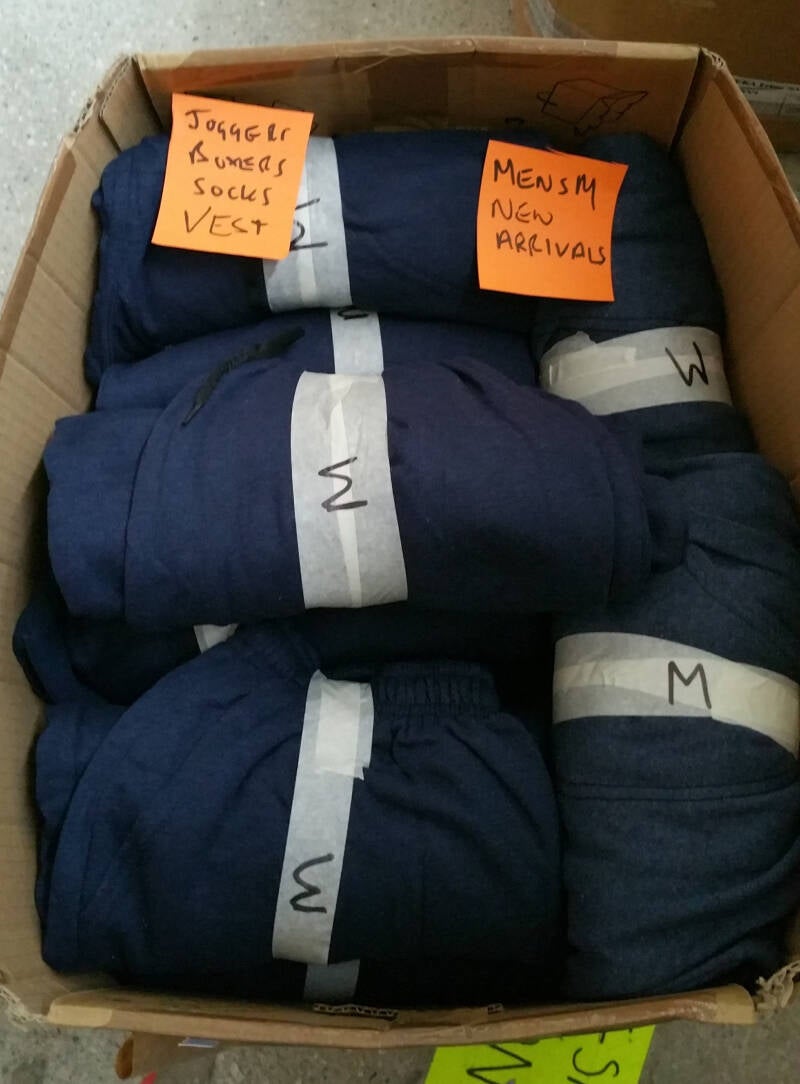
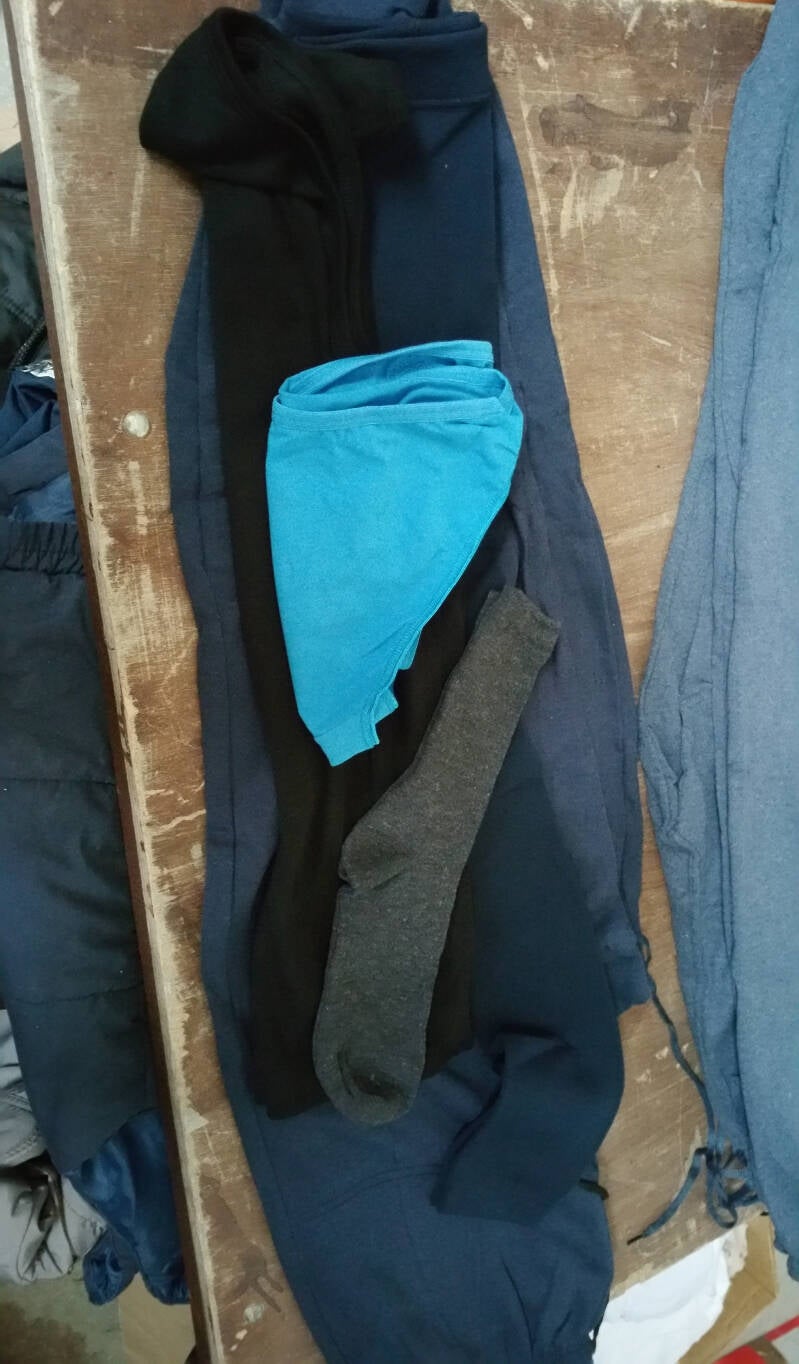
New Arrival Packs in Vathy, Samos
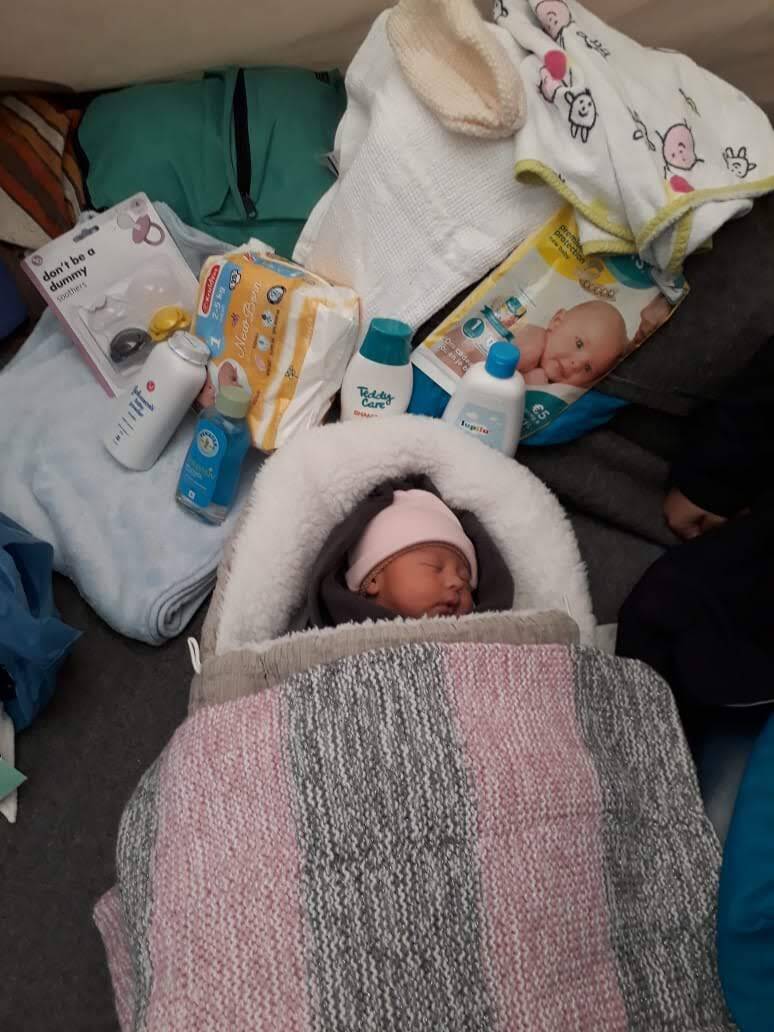
A New Arrival Pack Moria style
We also had a lot of four legged friends in and around the laundry. Our landlords had a dog that lived in the back garden and Khalid - one of our community volunteers - had been given a six week old puppy he brought to work every day. Snowy the puppy soon became the laundry mascot and slept under the desk when he wasn't roaming around outside causing mischief.
Khalid took Snowy to OHF one day and left him in a small box behind the kitchen where a visitor's child found him. Unfortunately the child - who probably thought the dog was a toy - picked Snowy up by a hind leg which snapped and Khalid rushed him to the nearest vet.
The cost to set Snowy's broken leg was more than we paid a community volunteer to work for us for a month and - as much as we all loved and cared for him - we couldn't justify spending more on a puppy than we did on a human.
Snowy came back to us limping badly and crawled into his bed and Khalid decided it was too difficult to continue caring for him in his shared tent, the camp was no place for a dog anyway - even one without a broken leg. So Snowy became more than our mascot and I ended up looking after him and taking him home every night.
As he recovered Snowy started getting up to mischief again and although he was tiny compared to the landlords' bitch the mismatched couple soon became firm friends and adventurers.
A neighbour brought them both home to the laundry one day - each led in by a piece of string round their neck. The man was almost hysterical with laughter - he'd found this odd pair trying to dig a tunnel under the fence into his hen house and thought it was the funnest thing he'd ever seen.
Snowy's leg mended on its own and a few months later there was no indication it had ever been broken. I looked after him for a while but Anastasia obviously wanted him and eventually persuaded Akis they should have a dog - so they gave Snowy a permanent home.


Snowy recovering in bed
His partner in crime


Planning their next adventure
Laundry puppies
and no - Snowy was not the father!
In December we had a group of visitors from the UK from Jessica Fostekew’s - The Guilty Feminist Podcast.
We got a brief mention along with OHF and Jonathan from Watershed and I listened to the podcast recently - I was too busy to at the time - and found it quite emotional.
Here’s the relevant part of the recording featuring Deborah Frances-White - who said lovely things about all of us - though she may have underestimated the camp population at the time.
Part five
A tragedy
Busy as we were, I still had to look after my business in the UK.
I’d been doing the company accounts remotely, usually sitting at the chart table on the boat in the evenings - but was now having to do that job at the laundry desk in between mad dashes to and from the camp - and I still had to go home occasionally to catch up and deal with problems that couldn't be solved from a distance.
Daniel Vogedes, who I first met and worked with on Samos flew over from Norway to help out and quite often covered for me when I was away. Daniel is a marine biologist and works on survey ships during the summer but usually has a lot of free time in the winter.
An old friend living in Edinburgh who I knew from Muscat in the Sultanate of Oman, where we both worked in the nineteen eighties, also came over occasionally to help out. In the Oman we had both been keen runners and walkers and we did the odd bit of climbing or caving together.
Chris Fenton is an accountant - now retired - and he first visited Lesvos in 2018 to volunteer with OHF. An enthusiastic cyclist and only sixty six years old, he had ridden his bike from Scotland to Greece via Holland, Germany and Italy.
I think his original plan had been to cycle down through The Balkans and along the East coast of the Adriatic - but his knee started playing up so he took a shortcut and caught the ferry from Italy to Greece - he always was a bit of a wimp. (I doubt if I could ride 20 miles let alone 2,000!)
During one of my trips home Chris flew out to manage The Lava Project and was in the building when a terrible accident occurred at the R4R premises a few metres away.
An Afghan woman had been issued tickets to collect clothes from their shop and had left her small child playing in a cardboard box on the car park.
A delivery lorry drove in and ran over the box killing the little boy inside instantly.
The mother’s screams as she realised what happened could be heard clearly in the laundry building - the sound of her screaming haunts Chris to this day.

Chris the intrepid cyclist and Daniel in Mytiline
Part six
The pandemic approaches
By the end of 2019 the number of people living in and around the camp passed the 20,000 mark and most days several blue police buses full of new arrivals drove in through the camp entrance - hundreds arrived every week and there was no way this could be sustained.
If you pay attention to the figures quoted here, the podcast above or carry out an on line search - you will realise there are discrepancies in the figures mentioned - the truth is no one actually knew exactly how many people there were in Moria but UNHCR figures put the total for the island at just over 21,000 in January 2020.
Food queues were chaotic - there were now around 180 people for each toilet (depending on which figures you believed) - tents had spread all over the hillside and people were giving up going to the toilet blocks and defecating in the bushes - they were also cutting down ancient olive trees for firewood.
As well as the 200 hundred unaccompanied minors in the Protected Area there were estimated to be another eight hundred (plus or minus a hundred or so) in what was now called “The Jungle” - no one really knew how many under eighteen year old boys there were - or where they were.


Moria Camp at the end of 2018
and at the start of 2020
The number of refugees walking through Moria village now resembled a crowd of supporters leaving a football match - there were so many of them - and of course hungry people were taking fruit from gardens and orchards - and whatever else they could find to eat.
The villagers had had enough and the local people were starting to take direct action. There was also trouble brewing at the location of the new Vastria camp where protesters were blocking the road to prevent construction traffic getting to the site.
There had always been a little bit of anti NGO/volunteer sentiment as well - though most of that was official rather than personal.
At the bottom of the road leading to OHF there was a prohibition for traffic crossing the faint double white lines - you weren't allowed to turn left in or out of the side road but everyone ignored the instructions - as they did most traffic regulations. No one wore seat belts or crash helmets in Mytiline and the police didn't seem to care.
But they did stake out the junction to the community centre and often issued fines to volunteers or confiscated their driving licences - we were the only motorists in town who actually had to obey the laws.
Towards the end of 2019 two vehicles belonging to OHF volunteers had been confiscated as it was illegal to keep foreign registered cars in Greece for more than six months.
Once again this type of offence would normally have been ignored - but two particular customs officers took this initiative and confiscated around fifteen vehicles altogether - all owned by NGO workers. OHF volunteer Ines got her Spanish campervan back eventually but Estelle lost her Belgian registered car for good.
And - as the situation deteriorated - the locals were starting to dislike us too.
~~~
During December I had taken the boat out of the water for winter maintenance and decided to sell her - after a lifetime of sailing, nearly fifty years worth, I think I'd finally fallen out of love with it. I'd had five proper boats as well as a couple of dinghies, crossed the Atlantic twice in small yachts and worked as a delivery skipper and Yachtmaster Instructor - but the boat was now just an expensive floating home.
With various friends I'd cruised her this far from the South of England but it seemed unlikely I'd make any more voyages in her. As well as being fully involved with the refugee work I was slowly getting poorer as my business was in gradual decline - not from neglect so much as the general economic situation at home - the boat had to go.
So - with the boat out of the water and in the yard displaying a "For Sale" sign I rented a small house in Moria village - which was a 10 minute walk to get to the laundry.

Bliss of Wight in Mytilini
In mid January, about six weeks after I moved out of Bliss to live in Moria, the locals started blockading the village to prevent refugees passing through - which added two or three kilometers to their journey to Lidl, OHF or Mytiline.
Walking through the blockade on my way home at night with Snowy the dog we were being shouted at and abused by the villagers, the women - who were often more aggressive than the men - sometimes spat at us.
Camp residents started protesting and had organised a march on Mytiline during which the local police used tear gas - everywhere the atmosphere on the island was becoming very tense.
But what was happening went unnoticed to the outside world - all the media was concerned about now was a new killer virus called Covid 19.
We all knew the situation on Lesvos was bad but no one could have predicted just how violent things were about to become.