Chapter One
Samos
~for Majida~
Introduction
This is the first in a series of stories about my time working with refugees in the Greek islands, starting in early 2017 and ending with the outbreak of the Covid pandemic. My involvement continued after 2020 but for reasons I'll come to in later chapters it wasn't practical for me to carry on working in Greece beyond March that year.
I had no previous experience of humanitarian work and was motivated to help by the horror of the Syrian Civil War.
My early career took me to the Middle East where I spent fourteen years (1982–96) living in Muscat and Dubai and my job involved travel to all the Gulf States and most of their neighbours including Yemen, Jordan, Lebanon, Syria and Iraq. During my time in Dubai I was married to a Syrian diplomat and as a result have two lovely half Syrian daughters who had relatives living in Syria throughout the war.
My own girls enjoyed safe, happy and secure lives in the UK attending good schools and universities and I wanted to do something on their behalf to help the less fortunate Syrians displaced by their terrible conflict.
Not everyone in the camps was from Syria, though they were probably the largest single group by nationality - there were also significant numbers from Iraq, Afghanistan and the Congo and smaller groups from Somalia, Sudan, Eritrea and other African countries.
There were and still are lots of children in the camps and every so often I've seen a little girl who's reminded me of one of my own daughters when she was the same age - I won't try to describe the impact such encounters had on me.
I’m not a professional writer and have never attempted a project like this before - but I think it’s an important story to tell, especially in the current climate where migrants, asylum seekers and refugees are the target of hatred and disinformation by many on the far right of politics.
This is a hugely complicated subject and my stories are told from the perspective of one ageing volunteer’s participation in events that affected tens of thousands of innocent people. Please be patient and forgive any lack of skill as I tell the tale of my personal involvement in a life changing time for many of those people.
~~~
My account starts on Samos, one of the five Aegean Islands where Reception and Identification Centres (RICs) were created under the European Union's “Hotspot” strategy introduced in late 2015 - around eighteen months before I arrived.
The Hotspot strategy was devised in response to the large numbers of people heading for Europe, mainly as a result of the Syrian Civil War that erupted in 2011. What started modestly in the first year of the conflict when around nine thousand Syrians travelled to Europe had escalated significantly with over one hundred and twenty thousand arriving in 2014 and a third of a million in 2015.
The strategy, which made the first European country a refugee arrived in responsible for processing their asylum application, was implemented during 2015 in response to this massive movement of people and the first Reception and Identification Centres (RICs) opened later that year. While waiting for their asylum applications to be considered the refugees lived in these camps where conditions were extremely bad - to say the least.
Under a deal agreed the following year between the EU and Turkey all refugees arriving in the Greek islands from Turkey could be returned if their asylum claims were rejected.**
In most cases the application process took a very long time and people were often held in these places for two or three years before being transferred, assuming their application was successful, to the mainland - if they were not accepted they were sent back to Turkey.
Living for so long in squalor and with an uncertain future took a heavy toll on the mental and physical health of many of the refugees and as volunteers we worked to support them and help alleviate some of their anxieties and frustration.
** The EU-Turkey deal involved a ten year commitment from the EU to provide six billion euros in funding for refugee related projects within Turkey - the majority of this had been spent by the end of 2025.
Samos, which lies on an almost straight line between Athens and Kusadasi in Turkey, is a beautiful scenic island and a popular tourist destination with a summer climate that's perfect for holiday makers.
Unfortunately, the weather helped to create conditions in the camp which were far less pleasant for the refugees - in July and August temperatures can reach 35°C and with almost no rain the heat and filthy surroundings attracted swarms of flies from spring through to the autumn.
Winters on the islands are harsh and cold with heavy, often torrential rainfall and hailstorms, it also snows occasionally - especially on high ground. When I was there in the winter of 2017/18 it was cold enough for snow to settle twice in the camp and Vathy town.
The camp was very close to Vathy, the capital of Samos, in what used to be an army barracks for troops stationed on the island. The military had stopped using the site many years before it was adapted to house refugees.
Vathy with the camp on the hillside behind the town

This was taken in 2020 and shows the original terraced barracks going up the hill behind the town
with additional tents and temporary structures to the left and right.
The shanty town spread as the population grew way beyond the original capacity.


The lower approach from town
Part of the camp from above with Vathy in the background

Samos with Turkey only two kilometres away across the Mycale Strait
Let me give a brief introduction to the individuals referred to in this account:-
Community Volunteers
Refugees who helped in and around the camp with volunteer groups. In this case they all worked with Samos Volunteers (SV) - some helpers lived in the camp and others had accommodation in the town.
Elias - a young Syrian Christian who before the war worked as cabin crew on Syrian Air, he lived in the house of an elderly local woman and helped her with chores and shopping.
Jonathan - who spoke excellent French, English and many African languages, a charismatic young man he had played for his national youth soccer team before leaving Burundi.
Majida - a Syrian Muslim in her 30s who had been a successful photo journalist before the civil war. She had worked in Egypt, Jordan and Dubai for a social media company but was in Syria during the carnage that destroyed her country and made her a refugee.
International Volunteers
There were many from all over the world, mostly young women who worked with Samos Volunteers - only four of them, all men, play a part in this account.
Gareth - a young New Yorker.
Greg - a 30 something Englishman.
Bradut - an East European in his late 20s, the lead coordinator of Samos Volunteers.
Me, Ross Ireland - a then 63 year old semi-retired businessman from Shropshire - a rural English county.
Refugees who lived in the camp
Fawaz The Philosopher - a former Syrian army officer who escaped the fighting and somehow got to Samos.
Harith, Ali and Mohammed - cousins from Irbil in Iraq in their 20s.
And finally - a quiet Syrian man who was sent back to Turkey before I knew his name.
Of course there were many other people involved in the events I'm about to describe but these were the main characters. The camp held around 2,000 residents in early 2017 and the population grew steadily throughout the year - and there were lots of different international volunteers and community helpers as well as camp employees, officials, police and army personnel. But the people I've introduced here were the ones directly involved in this story.
This chapter is an account of my first ten months as a volunteer in Greece - a member of the European Union since 1981 and theoretically a first world country. A lot of details, daily incidents and experiences have been left out and some of the people's names have been changed.
This video from 2016 gives an idea of the impact of the refugee crisis on Samos at the time
The video quotes a figure of a total of 60 million displaced people worldwide.
In the last ten years that number has more than doubled and there are no indications this trend will reverse.
The United Nations predicts further increases in displacement.
Part one
The first few months
I started working with Samos Volunteers in the Spring of 2017 and spent my first week sorting clothes in a warehouse about two kilometres from the camp. This was the established routine for all new volunteers while we underwent training and induction, we were then introduced to jobs that brought us into contact with the refugees.
SV was the only international volunteer group working on the island at the time - though some big NGOs like Medecins Sans Frontieres were also there and MSF supported Samos Volunteers in their activities, financially and with camp access.
In those early days volunteer groups didn't need to be registered in Greece - it was still fairly informal and SV had no premises of their own - just the use of others like the warehouse which belonged to the local Municipality.
The Paradise Hotel let Samos Volunteers have space for meetings and some of their language classes and most of our short term volunteers stayed there.
We also had a couple of rented houses the younger volunteers shared - I was too old to share and needed my own space so stayed at Paradise to begin with, but I often visited the volunteer houses - which were fairly chaotic and reminded me of my daughters' student digs.
I think everyone apart from Bradut, the lead coordinator, paid for their accommodation and all their own food and travel - Samos Volunteers was very much a grass roots organisation and our activities focused on helping with newly arrived refugees, distribution of clothes and blankets, serving hot tea to the breakfast queue, socialising, language classes, sports and games and schooling and play for the children.
As well as sorting clothes one of the first activities I was involved in was helping set up chess and other board games on the old olive grove on the hillside - just above the main road into the camp. We met there every afternoon at four o'clock sat on tarpaulins on the floor and played chess, draughts or backgammon with camp residents for an hour or more. Dozens of kids joined in so a play group was started to entertain them which was organised by Elias who was great at playing with the children and inventing new games.

Surrounded by children until Elias rescued me
During my time on the island boats carrying refugees arrived once or twice a week - the new arrivals usually came in the middle of the night from Turkey on huge inflatable dinghies that carried up to 50 people and they were brought to the camp in police buses from wherever they landed. They were then held in a small fenced area like a wire cage furnished with a few wooden benches while their fingerprints and personal details were taken.
Like Lesvos - which is the island thousands of Syrians came through in 2015 - Samos is very close to Turkey and its closest point is only a couple of kilometres across the straits - though the refugee boats usually set off further up the coast.
They could only carry a small backpack so they arrived with their phones, personal papers and very little else - most waded ashore, some swam and occasionally a boat foundered and they didn't all make it. Their clothes were usually wet and they were thirsty, tired and extremely nervous when they arrived.
Around forty percent of residents in the Greek camps are children and if the boat they were in made the beach without any problems they would be carried ashore by their parents or other adults and arrived in the camp with dry clothes.
By the time new arrivals had been picked up and brought to the camp it was usually mid morning but sometimes they arrived much earlier and we took it in turns to be on call for new arrival duty. This involved us going into the cage to hand out water bottles and dry clothes - anyone in need of medical attention was taken to the local hospital or the clinic in the camp.

New arrivals in the cage
The cage was located near a cluster of portacabins in the middle of the camp next to the clinic and reception area and we had shared use of one of the cabins. These buildings were used for office space, handing out food at meal times and other distributions like diapers and baby formula.
The camp was designed with high, barbed wire topped fences with gates to control movement and allow for all or individual sections to be locked down and isolated quickly - and this group of buildings was enclosed by a fence that created a corridor two to three metres wide around them.
We mainly used our space for preparing morning tea which we served to the breakfast queue from a window as the camp residents filed past but we also kept some clothes there for the new arrivals.
During my second week I visited the cabin and found our volunteer coordinator on her hands and knees crying with frustration as she tried to sort out clothes for forty wet refugees who'd just arrived and it was obvious that we needed to find a better way to organise this.
A couple of us approached our boss - the lead coordinator Bradut - with an idea that could solve the problem but involved spending some money, which for Samos Volunteers was in very short supply at the time.
We had a warehouse full of donated clothes being continually sorted but we asked if we could afford to buy new items for pre-prepared packs just for the new arrivals. The warehouse had everything from short skirts to fashionable coats but very few trousers or track suits and most new arrivals were wet to the waist - I think it's fair to say that whilst good children's and women's clothes are generously donated men tend to wear their clothes out and men's clothes, especially second hand trousers or jeans aren't so easy to get hold of.
Bradut agreed so we bought track suit trousers from the local Chinese shop along with underwear, socks and vests and those slip-on plastic sandals - sliders.
We made up new arrival packs with four items in a roll wrapped with masking tape marked M or F and the approximate size - we kept stock in the cabin with reserve supplies in the warehouse and had all sizes of sandals available so we were ready to hand out these basic items to everyone arriving in the cage.
New volunteers didn't engage with the refugees till the coordination team got to know them so this simple job helped them feel useful during their first week in the warehouse - and hopefully there would be no more tears trying to find clothes for lots of new arrivals.
~~~
Every six to eight weeks I flew home to check on my business, then went straight back to Samos. It was really disturbing to see the conditions people were living in and the way they were being treated and from the very beginning I was committed to helping them.
The camps were supposedly well funded but somehow the money sent to Greece by the EU was never reflected in the housing, equipment or quality of food - it was shameful for people to live like this in Europe and we were certain the terrible conditions were deliberate to deter more refugees from coming to the islands.
After my first trip home I went to work in the warehouse where a new American volunteer explained in great detail how we were going to prepare packs of clothes for newly arrived refugees - which looked just the same way I had originally organised doing it before I left two weeks ago.
The ethos of all volunteer groups was supposed to be egalitarian but whenever I went home for a couple of weeks I got a new boss who'd just arrived when I got back - the young American was called Gareth and he was from New York. To be fair - I was probably just as bad (or worse!) at his age.
~~~
One of my regular and most enjoyable jobs was preparing and serving the breakfast tea which required a small team of volunteers. We had three large urns which was not quite enough for the hundreds of small cups of tea we handed out - so to optimise our capacity we used half of one urn then topped it up, half the second one, topped that up then all of the third - by which time the first one was hot again.
Breakfast was collected from 8 o'clock around the corner from our window so the people were queuing by about 7.30 - a lot of the residents had their own cooking facilities so they didn't all come for breakfast or tea but we usually served six or seven hundred people every morning. MSF who did have money, provided the teabags and sugar for us.

Volunteers making tea
When it was my turn for tea duty I was usually in the camp before seven o’clock and the first job was to fill the urns - but for some reason the water supply to the cabin was often turned off and we had to take buckets to a standpipe next to some horrible toilets nearby.
The smell from these toilets was awful and contributed to the stench of human sewage and rotten garbage that hung over the whole camp. They were single portable cubicles like the ones used for music festivals and events and their contents were sucked out by a foul contraption that looked like a giant Henry vacuum cleaner - which leaked as it was towed around the camp.
There were overflowing rubbish skips which also stank and litter everywhere - and there were serious cockroach and rodent problems in the camp.


Newly installed toilets
they didn't stay this clean for long
This may explain the rats
Home Sweet Home
As the residents knew we were getting the water for their tea they helped us carry the buckets and let us jump the queue for the tap. They were always very orderly and everyone patiently queued for everything they needed every day - they seemed to spend half their lives queuing.
We couldn't fill the tea urns the afternoon before as another organisation used the cabin then and we couldn't use more urns as that would trip the fuse board. Nothing worked properly in the camp including the electrical supply and sometimes the power to the cabins was out all morning so the camp residents had their breakfast without a hot drink.
The breakfast was the same every day and mainly consisted of a very cheap croissant with an equally cheap carton of orange juice - though it wasn't as bad as lunch or dinner which usually looked like something you might feed to chickens - or even worse - something you'd already eaten. I ate a breakfast croissant occasionally but wouldn't touch anything that was supposed to have been cooked.
All the food was prepared off site by a private contractor who was probably related to someone in the camp management and it was delivered in undated takeaway containers which meant that old meals got mixed up with new - and one day a resident showed me their lunch which was purple rice covered in thick black mould. On another occasion I was presented with a tinfoil carton full of lentils in some sort of gravy with dozens of maggots swimming around - the best thing about breakfast was it usually had a piece of fruit with it.
At least they knew their tea was freshly made and hot and sweet, though we limited the sugar to two spoons a cup - which caused a lot of complaints. After I'd been there a few weeks we bought lemons so the refugees had the choice of adding a slice to their tea which improved the flavour and added some much needed vitamin C to their diet.
It was serving the breakfast tea where we first met Fawaz - The Philosopher.
Every morning Fawaz brought herbs he'd collected from the woods on the hillside which he always had in his own tea and he brought enough for the volunteers and several others - his herbs and a slice of lemon were a great improvement.
He always had something interesting and philosophical to say and that's how Fawaz got his nickname - which he was immensely pleased with. It was also how we heard his story - how he had been taken prisoner after surviving a fire fight and then escaped and much, much more. Given the chance he would probably have told us his stories all day and if we didn't cut him short occasionally it would have been impossible to get any work done.
He was one of hundreds in the breakfast queue but stood out with his quirky stories and strange tales from the war he'd escaped. He was adamant Zionist conspirators would never allow him to be given asylum in Europe and as with a lot of his stories - I didn't always understand what he was talking about. Though he was right about the end result for him - he wasn’t allowed to remain in Greece and was eventually deported back to Turkey.
Over time we became friends and it was through Fawaz that I was introduced to what was soon to become one of my main activities - visiting refugees detained in the local prison cells.
Part two
The Alpha Centre
On one of my first trips home I arranged a fund raiser at a local pub for Samos Volunteers and collected over £700. An old sailing friend Ian Mitchell came up for the night with his guitar and promised to arrange a similar but much bigger event in his home town - which he did - raising another £5,000.
Others were busy fund raising around the world and it was soon time to step up and get our own premises - we opened the Alpha Centre, the first community centre for refugees on Samos, in the summer of 2017.
I've always been a keen sailor and over the years have owned several boats and the one I had then was in Lefkada in Western Greece - so I took time out and with Ian's help moved her to Samos. I couldn't keep staying in the Paradise Hotel and was going to need the tools I kept on the boat!
I'm definitely not a skilled tradesman and my friends who are would have laughed at some of my efforts - but I was better with my hands than a lot of the younger volunteers and did have my own tools. The building we leased was in a great location between the camp and the town and was perfect for a community centre but it needed lots of improvements - so we got to work.
Greg Oke - a sound engineer and film producer arrived to volunteer for a couple of months and we started off by converting the big dirty basement into a welcoming mother and child space. Assisted by Jonathan and several others from the camp, Greg and I were the cowboy builders of Samos Volunteers - and we wore stetsons to prove it.
Here’s a short video of the cowboys at work:-
Helped by Jonathan, Steve Smith, Toffee, Joel and many others - all supervised by Natalia
Greg's main contribution and lasting legacy for the group was compiling and publishing a cookery book
Displaced Dishes
refugee recipes that found their way to Samos
It's still available and the profits go to SV

https://displaceddishes.com/product/the-book-en/
Jonathan and I kept bumping into each other on different jobs and we appeared together in a photo for the Samos Volunters Xmas message that year with another young Burundian, Adams.

Jonathan, me and Adams
during a break from preparing new arrival packs
(I've often wondered if this photo might have a touch of white saviorism about it!)
Jonathan made a great contribution to Samos Volunteers then moved to Lesvos, where I went next.
On Lesvos he worked with MSF as a translator in their trauma clinic, spending his days helping support people who had been tortured or severely injured - work that most of us would find very difficult in any language.
Part three
Getting settled in a new way of life
Harith and his cousins, Ali and Mohammed, were regular visitors from the beginning of the Alpha Centre and he soon started helping me with the jobs I was attempting.
With his help we built shelves and cupboards, somehow created a very basic kitchen and generally fixed lots of things. Whenever he finished queuing for whatever he was queuing for he would find me and start helping. He always seemed cheerful and happy and smiled all the time - I'm sure he was very amused by my clumsy construction efforts and was keen to witness whatever I botched next.
One morning he came in very late - not from delays queuing in the camp but dealing with news from home.
Harith had worked as a driver at an oil installation in Iraq and ISIS - the self styled Islamic State of Iraq and Syria - “persuaded” workers to help extract crude oil for sale on the black market - which was one of the ways they financed themselves.
The news from home was that his mother and father had been visited and badly hurt as local ISIS "soldiers" tried to find Harith to make him work for them - they didn't believe his parents when they said he'd left the country and tried to beat the truth out of them. He was obviously incredibly upset.
I came across something similar the following year on Lesvos.
An Iraqi man in the camp with his family worked with us as a community volunteer and one of the small benefits they got for helping was a fortnightly laundry of their clothes and bedding. But this man brought clothes every couple of days and insisted on having them washed - he was such a nuisance one of the group coordinators eventually fired him.
The Afghan woman who looked after the laundry room had been a doctor in Kabul before the Taliban killed her husband, she spoke good English and we knew each other so I checked with her and she said the clothes our helper brought always smelt of urine.
It turns out the man’s daughter, who was sixteen by then, had been taken hostage by ISIS when she was twelve to make her father work for them - the sexual abuse she suffered had left her incontinent.
Some friends and I made sure the family had sufficient adult diapers for her till they were transferred off Lesvos to the mainland a couple of months later - unfortunately it was all we could do for them in the circumstances.

Harith at The Alpha Centre

Cousin Ali and Harith in Germany in 2022
Meanwhile back on Samos - volunteer life was good and I was enjoying my new experiences even though the work was often emotionally demanding - and at my age it could be physically tough as well.
It was very satisfying to be doing something useful - however small - to help these people who had been through so much before they found themselves trapped in the awful conditions of the camp.
I felt as if I was settling in well - then one afternoon while playing chess at the old olive grove there was a commotion high up in the woods on the hillside and we realised a man was attempting to hang himself from the branch of a tree. Greg and Elias were the first to reach him but I was too slow so watched as they held him and untied the rope around his neck.
We all knew how the mental health of the refugees was being affected by the uncertainty of their existence and the hopeless way they lived - but it was still terrible to see someone attempting to take their own life.
In the first couple of years volunteering I found it was quite stressful being in or around the camps, though like most things I suppose I eventually got used to it, but after seeing what had just happened I was more stressed than usual.
I smoked small cigars then and nearly always wanted one after visiting the camp and now I wanted one quite badly - so instead of waiting I lit up as we packed away, offering the pack of cigars to all the people we'd been playing chess with.
A very quiet Syrian man I hadn't seen before accepted and we chatted briefly as I gave him a light.
~~~
Our most active and prominent community volunteer was Majida who was just as energetic and busy as Jonathan. She has a silly, mischievous sense of humour and when someone asked her one day if she had any children she instantly came back with “Yes - twin boys, Ross and Jonathan!” - she's been referring to us as her twins ever since.
Amongst her many activities Majida taught volunteers Arabic and refugees English, cooked for special occasions, translated for Dr. Manos who helped camp residents and had her own pop up tea and coffee service - Majida's Kitchen - which she opened most evenings near to the portacabins in the middle of the camp. Occasionally, if I wasn't too tired after a busy day I went back up to the camp to help her.
It was very different to morning tea where a team of us served a long queue from a window. Majida used a small area in one of the cabins to prepare the hot drinks then brought them outside in thermos jugs. Mingling and chatting while pouring the drinks was much more sociable - though she didn't have anywhere near as many customers as we did at breakfast.
As the camp population continued to grow we began running out of hot water for the morning tea and were having to close the window with lots of people still in the queue - we would show them the urns were empty and they simply shrugged in resignation. They rarely got upset or aggressive about anything, instead they accepted their new lives of constant queuing and waited patiently for a decision - which if they were lucky might open the way to a better future for them.
A few days after the attempted hanging the quiet Syrian man from chess came to Majida’s Cafe for evening coffee. His English was excellent and during a break while Majida refilled the thermos jugs we sat on a bench made from pallets and I offered him a cigar while we talked.
He held the pack and asked how much they cost, I told him they were six euros and his reply got firmly lodged in my mind “Look at what my life has become" he said sighing with despair "I can't even buy a pack of these.”
As usual I didn't know what to say.
Humanitarian workers are supposed to follow basic rules and the first and most obvious one is to do no harm. Lay volunteers aren’t trained as counselors so we try to listen as well as we can - but asking a lot of questions can cause problems or trigger bad memories and I thought it best not to comment.
I was once involved in teaching English to refugees and one of them asked me about my background, so I explained my situation then stupidly asked about his - he told us all how many of his family he had lost and how they died and became very distressed.
Volunteers like me aren't qualified to deal with this sort of situation - so the basic rule is to listen - but that's all.
When Majida came back with fresh coffee I started to get up and the man put his hand on my arm and asked me to stay a little longer and I said I'd be back once we'd served more drinks - but when I looked for him a few minutes later he'd gone.
I felt guilty about cutting short our conversation and sorry for him not being able to afford a small luxury so I thought about how to try and cheer him up. I liked him and he was obviously a good man - maybe a simple gesture would help. I decided to buy a fresh packet of 20 cigars in the morning and offer them round later after chess, then I would give him the rest of the pack. I thought that would be a simple way around our rules - after all - it's not a gift if it's already open is it?
Favouritism and giving gifts was frowned upon - though of course we all had favourites and we all bent some of the rules occasionally.
The selection of community volunteers was the most obvious favouritism - they were always the brightest with the best English and were nearly all good looking young men. This naturally led to chemistry between the international volunteers (who were mostly young women) and community helpers and there were a lot of interactions that were supposed to be taboo.
During the four years I volunteered in Greece I knew of many relationships between female volunteers and male refugees but, despite the scandals over sexual favours expected by charity workers in other countries, I never saw any between male volunteers and female refugees - though there were rumours about an older SV volunteer who was sent home just before I arrived because he was involved with a young Afghan girl.
The day after chatting with the man at Majida's Kitchen I went with the usual team of volunteers to prepare games at the olive grove with a fresh pack of cigars in my pocket for him - but he didn't come to play chess that afternoon.
As we were about to pack up an hour later several policemen ran down the road from the gate shouting - and after a few minutes my quiet new friend was led back to the camp - his was the second suicide attempt that week.
For a few minutes I was in shock - if I'd been more experienced or confident I would have tried to help him and followed the police into the camp to see what happened next - instead I did nothing as they led him away to the clinic.
Many countries offer voluntary return schemes for asylum seekers and in the UK the Home Office can pay people expenses and cash of up to £3,000 if they agree to go home and at the time the Greek authorities had a similar system - they offered refugees the opportunity to "self deport" with a cash incentive of €500.
I was told later that in the case of attempted suicide there was a standard procedure - the person was sedated, “signed” the self deportation papers and sent back to Turkey with the money shoved in their pocket - though given the level of corruption I've often wondered how many actually got the €500.
I didn't see the man again and I never knew his name.
And - I never ever cut short a conversation with a refugee again, even if it meant listening to The Philosopher telling his incredible stories all afternoon.
If only I had been more patient the night before and shared another ten minutes with the quiet man - could I have made a difference?
As for the camp police -
They weren't all bad - during a hot and short staffed new arrival distribution one helped us pass out the water bottles - then he went home to fetch some of his own family's clothes for the children.
There was always some kindness amongst the indifference and casual cruelty of life in the camp.
~~~
A few days after the quiet Syrian attempted to kill himself Fawaz - whose asylum application had been rejected twice - was arrested by the police in Vathy.
Part four
Prison visiting
When refugees arrived they were issued with ID papers, the colour of the paper and the stamps on it signified their status within the system. If you were rejected, appealed and rejected again your papers showed your “2nd rejected” status.
At this stage you were in limbo, not a refugee being processed or a visitor entitled to be there any other legal way. The application process wasn't connected to anything else - whether you were accepted or rejected you just walked back out onto the street.
The police could ask to see your papers at any time and if you were 2nd rejected they could arrest and detain you for three months without any other process or judicial oversight and it was a very common sight to see policemen in pairs or small groups checking the ID papers of refugees as they walked in the town.
What was so bizarre about this was that many people successfully appealed after 2nd. rejection and were accepted. I never understood this crazy, cruel system which seemed designed solely to create fear and uncertainty - was it really just another deliberate way to deter people from coming to the islands?
Detention involved being kept in a holding cell in the local police station and they were using a dimly lit room about ten metres square in the main station in Vathy - this space had no natural light and only one toilet and sink. The cell was used to hold up to forty people but fortunately for Fawaz it was already full and he was sent to the cells in Karlovasi further up the coast.
I went to the camp to collect his possessions and took them to Karlovasi then visited him twice a week until he was released three months later.
His cell was like something from a Western movie, all bars with three or four people lying or sitting on single metal beds with a sink and toilet in the corner - the only good thing about being detained was the food was better in prison than in the camp.
Visits were about chatting, taking fruit or small treats and cigarettes, something to read and making sure he had credit on his phone, which prisoners were allowed to use for a short time each day. Visitors could sit near the bars but no hand shaking or other contact was allowed - and you couldn't pass them anything yourself as everything had to be checked.
The police were ok but occasionally they were bad tempered or busy and refused to let us see him - though as far as I know Fawaz wasn't treated badly.
~~~
Harith continued assisting me with maintenance jobs, smiling as always, and one day - with his bemused help - we managed to hang a cupboard door that actually worked on a lopsided frame instead of making the frame vertical first. He seemed more puzzled by my efforts than usual but was always too polite to say anything critical.
A few weeks after the incident with his parents he was very late again as he had more bad news from Iraq - a bombing in the market of his home town had killed around sixty people including more than a dozen of his extended family. When Harith came to find me he was very agitated and upset - and he wasn't smiling anymore - once again I was lost for words.
Iraq was “liberated” in 2003 by a US-led coalition inspired by President George W. Bush and supported by the UK’s then Prime Minister - Tony Blair. “Operation Iraqi Freedom” officially involved a coalition of 49 countries, though in reality it was the work of Bush and Blair.
Between 2003 and 2017, the Iraq Body Count Project recorded at least 180,000 civilian deaths from violence in addition to the estimated 30,000 Iraqi military personnel killed during the invasion itself.
Such was the overwhelming capability of the coalition that the "liberation forces" suffered less than 180 fatalities.
The most spectacular use of hi-tech weaponry was shown on global television - presumably to demonstrate the United States technical and military superiority.
In the spring of 2003 we watched the “shock and awe” campaign from the comfort of our homes as precision-guided bombs were steered into ventilation shafts, blowing buildings apart from the inside to ensure maximum death and destruction.
Saddam Hussein was a tyrant but since his removal in 2003 Iraq has struggled to become stable and the violence against civilians continues to this day - but thankfully the number of people killed is getting smaller, nowadays it’s “only” four or five hundred a year.
An unintended consequence of the Iraq War and the years of instability that followed was that the border between Iraq and Syria - the arbitrary Sykes-Picot line drawn on the map by the British and French and implemented after the First World War - was harder to control.
The border had always been difficult to monitor but when the Syrian Civil War broke out it became almost completely porous and ISIS and other fighters could move easily between the two countries.
Not only did Bush and Blair’s invasion lead to the deaths of hundreds of thousands of Iraqis, but their actions indirectly helped to prolong the agony of the Syrian conflict - a civil war that cost at least six hundred thousand lives.
At the time of writing this chapter the current US president is openly asking to be awarded the Nobel Peace Prize for resolving another one sided conflict in which the United States is the main supplier of arms. Weapons continued to be supplied as he apparently brokered peace but the killing of Palestinians didn't stop and neither did the confiscation of their land.
As part of this "peace process" Tony Blair was reportedly being considered as a future Governor of Gaza - which is such an obscene idea it makes me feel quite ill.
~~~
Meanwhile the camp was getting busier - new arrivals outnumbered those processed and transferred to the mainland and the authorities were running out of space.
The camp was built on a hill and arranged in terraces of portacabins and isoboxes with cabins for offices or supplies and boxes for the people. An isobox is basically a converted 20 foot shipping container with a tiny bathroom in the middle and a room on either side.
Two families or 8 individuals per box was the usual arrangement and if that sounds cramped it was - but at least it was dry. The capacity of all the fixed accommodation in the camp including isoboxes was around 800, the rest of the people lived in tents or shelters made from wood, plastic sheets or corrugated iron.
By late Summer the space within the camp’s perimeter fence was full with many tents set up between the terraces and boxes - new arrivals were being sent out onto the hillside and tents were starting to appear around the edge of the olive grove.

The old olive grove before it was covered in tents


Living the Dream
This looks fine in the sunshine but was pretty grim in the winter
This video was first posted when I was on Lesvos but had actually been filmed earlier in Vathy camp. It doesn't make any difference - conditions were about the same in both places
Some people put pallets down first with the tent pitched on top which helped prevent rainwater from flooding the tent - unfortunately this also made a good place for rats to live.

There weren’t always enough tents for the new arrivals and sometimes they spent their first few days
without shelter
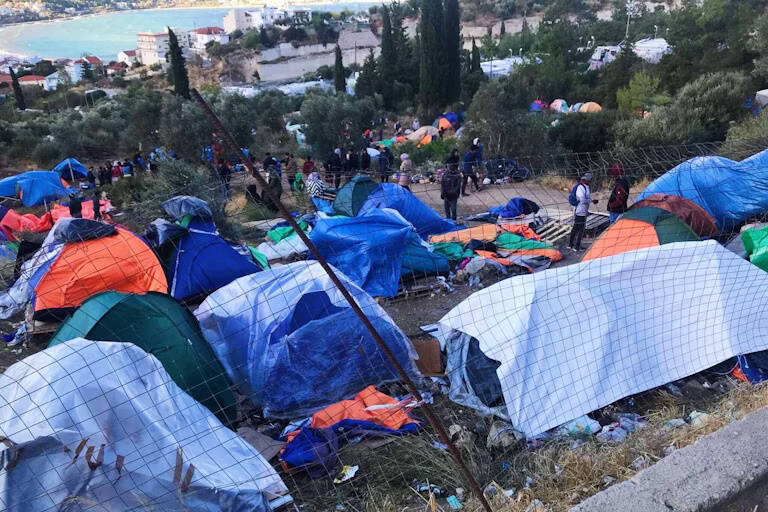
The camp was gradually spreading across the hillside
~~~
I made another trip home and when I got back Elias, who also had 2nd rejected status, had been arrested.
The younger volunteers had arranged a beach barbecue near Kokkari 10 minutes outside the town and Gareth was driving one of our small hire cars to the party - the car was overloaded with six passengers, all international volunteers apart from Elias. The police stopped the car, checked his papers and took him away - they didn't do anything about the overcrowded vehicle or notice the volunteer hiding in the boot of the car.
Why Gareth didn't make two trips I'll never know, it was only a bloody party - he seemed unfazed and unrepentant and I was absolutely furious with his stupidity.
Elias was held for three months in the Vathy lockup - with barely enough space to lie down and no daylight, the only window was inside in a tiny room just off the cell - built for lawyers visiting their clients.
One of the SV co-ordinators tried to visit him everyday but didn't usually succeed and I was pretty sure her persistence annoyed the police. I went with other volunteers once a week and we were sometimes allowed to speak to him through the glass - from there we could hear moaning, groaning and screaming coming from inside the cell - the sounds of people slowly going mad.
Before locking up refugees in the main police station they used a room behind the customs office on the quayside. I had been there one day when four men were led out of the building - handcuffed and chained together at the waist and ankles they shuffled, emaciated and blinking into the daylight.
Who knows what was happening in these places.
Elias was fortunate, he wasn't treated badly and the police asked him to help with translating - during his third month some of the policemen would even let him out of the cell to sit with us. His biggest problem, apart from being innocent of any crime (except of course that he was a refugee) and being locked in a dark, filthy room with forty other people - was toothache.
I was seeing a dentist at the time and told him about Elias and he offered to treat him and check on the others if he was allowed into the jail - he explained that any treatment he gave would have to be limited to the equipment he could carry.
So I went to the police station and asked if the dentist could be allowed in and was taken to meet the Captain in charge - he said he would email Athens about the request and I should return a week later for the reply.
On the day I was due to go for an answer Harith and his cousins were arrested.
As the camp got busier with new arrivals and there were more families with children it needed to be reorganised and a whole terrace of boxes housing single men was going to be used for families. It was late Autumn by then and it was getting colder and wetter - winter was approaching fast and the storms and torrential rainfall make living in a tent almost impossible.
Harith, Ali and Mohammed were ordered out of their isobox, given tents and told to camp in the woods - when they protested the police were called and they were handcuffed and taken to the station in Vathy.
At the Alpha Centre we heard what had happened to them by early afternoon.
At 4 o'clock I had my appointment to discuss the dentist's visit so went to the police station and an officer showed me to the Captain's room.
On the way we passed Harith and his cousins on a bench in a corridor. Their wrists were cable tied behind their backs and their upper arms were bound - they were trussed like poultry with their heads between their knees.
I told my escort that I knew them and asked to speak to them but he pushed me along the corridor and they kept their heads down. When I met the Captain he informed me the request for access for the dentist was denied - and not to make any more attempts to talk to prisoners.
Harith told me after they were released that later that night the three of them were taken to a room where they were badly beaten.
As the cell in Vathy was full they were sent off to different police stations around the island. Harith was held in Marathacampos, a village miles from town at the other end of the island and with some of the other volunteers I did my best to visit every week. We usually met the same policemen who were ok with us and they seemed to be kind and sympathetic to him too.
His tiny cell for one had a solid steel door with a small barred window high up and when we visited he gripped the bars and stood on tiptoe to talk to us - smiling as always.
I didn’t know Ali and Mohammed as well as Harith and was very busy so didn't visit them as often, which was something I regretted later, and although their detention had nothing to do with 2nd rejection they were all held for three months, once again without any court procedures. The police appeared to be able to do whatever they liked with the refugees.
One afternoon, after he'd been in prison for more than three months, Elias was told he was free to go.
The first we knew of his release was when he arrived at the old olive grove where we were setting out games - the only thing he wanted to do when he was released was play with the children again and seeing him brought tears to my eyes.
After packing away we went to the dentist together and I paid for his treatment.
The following evening Bradut arranged a welcome home reception for Elias and there was a ridiculous ceremony with stupid, vacuous speeches, ending with Elias having to walk across the room to shake Bradut’s hand and accept a presentation gift - the whole performance was bizarre.
Being the boss seemed to be going to his head - Bradut loved his own celebrity and any kind of ceremony - he clearly cared more about his own image than he did about the refugees.
After a series of relationships with many of the female volunteers he had recently settled on a pretty young German woman - some of us were becoming convinced Bradut didn't actually like the refugees and humanitarian work wasn't his main reason for being there.
Part five
Majida
A week or so later I was driving with Majida to the airport to say goodbye to a volunteer leaving the island and we talked about how terrible it was that Elias had been detained in prison.
I already knew some of her story from the Syrian Civil War -
Of cities divided and controlled by different groups with checkpoints everywhere and communities fighting on different sides. And of Assad's army - backed by Putin's military might - barrel bombing civilians from Russian helicopters and using chlorine gas to clear rebel fighters and their families hiding in cellars during the siege of Aleppo.
Tima Kurdi's book The Boy on the Beach contains harrowing stories of kidnap, random violence, imprisonment and torture by all sides in the war.
She relates how her brother Abdullah (Alan Kurdi’s father) was detained by unidentified foreign fighters for over a week while attempting to get to his work in Damascus. They hung him like an animal carcass along with several other men from the ceiling in an abandoned house and tortured him every day - then they ripped his teeth out with pliers before letting him go.
Apart from using Syria to fight proxy wars with the West (the USA), Russia always had a strategic interest in the country.
Between Northern Lebanon and Turkey lies a one hundred and eighty kilometre stretch of Syrian coastline which is the country’s only access to the sea. The ports of Latakia and Tartouse are in the homeland of the Alawite tribe and the Assad family are Alawites - they originally come from the small town of Al Qardahah not far from the coast.
Until 2024, when Bashar al-Assad was finally overthrown and fled to Moscow, Latakia and Tartouse were the only ports in the Mediterranean the Russian navy had access to - so the Russians had always supported the Assads.
During the fourteen years of the civil war the United Nations recorded dozens of occasions when chemical weapons were used by the Putin backed Assad regime - Sarin as well as Chlorine.
But while these atrocities happened the UK welcomed Russian Oligarchs and their money - we sold football teams, businesses and swanky London properties to Putin's cronies while he helped Assad brutally murder his own people.
Boris Johnson even appointed the son of an ex KGB man to the House of Lords - the UK only objected to Putin’s behaviour when he invaded Ukraine.
It seems to be the view of western governments that Arab lives don’t matter as much as white ones, just look at what happens in Palestine - not just in the last few years but ever since the 1920's.
A civil war has to be the worst type of conflict and it took Majida eighteen months to cross her country to the Turkish border. Known to be a journalist she spent a lot of that time imprisoned and interrogated by different groups fighting in the war.
Of Elias’ experience she had this to say -
“Yes, what happened was awful, but at least he didn't have the beating or the electricity or the rape.”
I had never asked Majida directly about her experiences before, but now she seemed to want me to.
So as gently as I could I asked which of those things had happened to her and she replied very quietly -
“All of them, but I am happy now.”
Her words almost broke my heart.
Part six
The final months on Samos
Volunteer life went on - serving tea in the morning, fixing shelves, making and painting blackboards, playing chess, visiting people in prison and listening to Fawaz’s amazing stories as he had been freed by then as well.
I was also having discussions with lawyers in London and on Samos and with the refugees I knew who had been imprisoned by the police.
Clearly, the arbitrary detention without daylight, extreme overcrowding, refusal of medical care and lack of exercise and fresh air inside the Vathy police station amounted to inhuman treatment, if not outright torture, and a local Human Rights lawyer had offered to take a pro bono case against the Greek Government to the European Court of Human Rights.
I spoke with all the refugees I knew who had been arrested and detained and they were all very angry at first and wanted to give statements - but by the time they had been out of prison for a few weeks they changed their minds and just wanted to concentrate on their asylum applications.
Although their identities would have been confidential they were too scared to get involved - they somehow came to accept their incarceration as part of their journey.
~~~
I was "promoted" and made responsible for cash and carry shopping with a card and account paid for by MSF.
On one shopping trip I stupidly bought ham sandwiches as part of a packed lunch for a group of boys being taken on a day out - whether they knew the meat was from a pig or not didn't seem to matter - they ate the lot before leaving the building.
Despite this silly mistake I was still first in line for another promotion -
Scabies was widespread in the camp and MSF proposed financing the installation of a laundry facility for SV to operate for them. As scabies mites and their eggs get into clothes and bedding these have to be hot washed and dried to kill them - otherwise the patient is reinfected almost immediately.
Setting up the laundry was to be my responsibility but before the project started I decided to move to the island of Lesvos where the infamous Moria Reception and Identification Centre was the worst refugee camp in Europe with nearly 9,000 residents - rising to 21,000 two years later.
I joined One Happy Family (OHF), a Swiss volunteer group running the biggest community centre for refugees in Europe in the spring of 2018 - it wasn't perfect but was in a different league to Samos Volunteers.
In 2019 I set up a new NGO, The Lava Project (TLP), with the help of OHF and seed finance from the UK charity Help Refugees, now renamed Choose Love.
At The Lava Project we ran a laundry in a small industrial unit in Moria village near the camp and over time we bought and installed commercial machines with sufficient capacity to wash, dry and heat treat the equivalent of 150 domestic loads of washing a day.
We worked with MSF and other clinics on scabies treatment in the camp and when fully commissioned helped treat around twenty to thirty individuals a day.
Not so many when you consider that of the thousands of residents half the people had scabies with 40% of the camp and patients being children - though those twenty to thirty patients did bring a lot of bags of washing.
MSF treated the most severe cases of scabies amongst families and Kitrinos, a British NGO, treated the single men. Whole families including babies with scabies is pretty grim - but that's for another chapter.
We did other work too with vulnerable groups, washing clothes for the unaccompanied minors, bedding for unaccompanied children and everything for single mothers with babies. There were at the time 60-80 children without parents in the Safe Zone and about 120 single mothers in the Protected Area of the camp.
People often asked me how they came to be refugees when pregnant, not understanding most of the women had been raped or paid a smuggler, policeman or border guard with sex during their journey - hardly any of them knew the fathers of their babies.
I worked in Lesvos helping support the people of Moria camp until the outbreak of the Covid pandemic in March 2020.
~~~
What happened to my refugee friends from Samos?
Harith now lives in Manchester in the UK and works as a welder.
We met for coffee in 2024 as I wanted to hear about his life since Samos and as usual he smiled all the time we talked.
I visited him again in early December 2025 and went to see his small, spotless flat he was so proud of and he told me all about his driving lessons - it was wonderful to see him settled and happy.
He also told me that having lost most of his Iraqi relatives he's ready to create a new family of his own now in England.
His cousin Ali lives and works in Germany and Mohammed went back to Iraq after arranging for the political offences he was accused of to be dropped - I suspect a touch of bribery may have been involved.
Jonathan lives in Cyprus - still working in the refugee business, he is married to a Greek girl and they've started a family - he recently sent a photo of him with his baby boy.
Elias is in Germany helping to run a chain of coffee shops - also with a partner and young child.
Majida has Irish residency and lives and works in a beautiful town in Donegal. She is single, happy and surrounded by good friends.
She risked returning to Syria recently - possibly for the last time.
Here is Majida with my dog Bushi in Derry last summer (2025):-

Fawaz the Philosopher wasn't successful in his asylum application and was sent back to Turkey.
He spent a couple of years working illegally in real estate sales in Istanbul before being forced to leave - we kept in touch and he offered to sell me an apartment but I managed to decline his proposal.
While in Istanbul he bought and sort of learnt to play a lute - his singing is almost as strange and wonderful as his stories, it really is impossible to describe.
After he left Istanbul he moved to a town near the Syrian border to wait for the end of the war, where he now works on a small farm.
More than 10 years after leaving Syria Fawaz continues to wait until it's safe to go home.
I never found out what happened to the quiet man who came to play chess with us in the old olive grove -
until I asked Majida for her approval to include her experiences in this story.
She sent the following message:-
“The quiet man's name is Hassan, and he is now in Turkey. He got married and has two children. He married a girl he had known in the camp named Zainab. She also requested to return to Turkey, even though she had been granted asylum; however, she preferred to return and marry him.”
Footnote:-
In the first Vice video - When We Were On The Sea - Lily Cole interviewed the journalist Amal. This was Majida using an assumed name.
Here are Majida's reflections on her time in Samos 8 years later:-
“The camp, with its tents and makeshift shelters, held countless secrets of dreams and sorrows.
Walking to the olive grove or going to the Alpha school was a daily journey between hell (the camp) and paradise (the outside world). Despite the short distance, it was a unique human experience—an opportunity to listen to others, to recognize the humanity of the refugees, and to treat them as human beings without discrimination based on their skin color or cultural background.
That place, created by the volunteers with their friendly and supportive approach, became a gateway to positive change.
Now, years later, after thousands of faces and stories have come and gone, I am grateful for every face, every smile, every kind word, every friendly touch, and every measure of patience and love I received from friends who embodied the true meaning of friendship. Every day was an experience, and every experience brought about change, and every change contributed to shaping a life I would never have known otherwise.”
~~~
This account was mainly written during September and October 2025 with the help of Majida Al Askari, now of Buncrana, County Donegal.
The last thing I did before concluding this chapter, which was written after visiting Majida during the summer, was to confirm with her yet again that I could name her and refer to her very personal experiences.
I wanted to be absolutely certain she was happy to be quoted in full - here is her reply -
“My friend, I was afraid to share my name for fear of my family and my brothers who were detained by the unjust Assad regime, but after confirming their death, I no longer fear anything.”