Chapter Six
The Chaos and the Closures
Introduction
During March 2020 - while the rest of the world was planning for the approaching pandemic - the European and Greek authorities started to address the refugee crisis with more aggressive and ruthless tactics.
The majority of refugees came by sea to the Aegean Islands and of the two possible overland routes from Turkey the Greek border was far busier with attempted crossings than the Bulgarian one.
The main land crossing from Turkey to Greece is the border that follows the Evros river for 200kms and on the 3rd of March senior EU leaders flew to Evros to declare Greece "The Shield” of Europe, promising more funding and support. The announcement was intended to make it clear the EU would not negotiate under pressure and that the Turkish open-border tactic would not extract more financial aid or concessions - under the 2016 EU-Turkey deal some six billion euros had been allocated for projects within Turkey and the EU wasn't inclined to spend more.
The Greek government had already sealed the land border, deploying the army and police and blaming Covid, but mainly in response to Turkey’s actions - they had also suspended registration of asylum claims.
The Turkish Government soon reversed their 27th February decision to no longer prevent departures to Europe and the surge in small boat departures only lasted a week before collapsing. Instead of encouraging people to leave they were now blocking access to beaches and pushing people back inland - and at the same time the Greek Coast Guard and Navy ramped up their response.
During January and February 2020 nearly three thousand refugees had been recorded arriving on Lesvos but in the following six months to the end of August only twelve hundred arrived in total, illegal refouling of refugee boats was now the norm - and so was using the refugees as pawns in a political game.
In response to the growing pressure from the locals the authorities had also accelerated the processing of asylum claims and relaxed the stringency of their procedures. The number of transfers to the mainland increased dramatically and by the 2nd of September when the first case of Covid was reported in the camp the population in Moria RIC had nearly halved to approximately twelve thousand.
The riots and fire of the 8th September that totally destroyed Moria camp left these twelve thousand people living in the open and prevented from moving by police road blocks.
Part one
Mavrovouni
The authorities decided the only location for a temporary camp was the army firing range below OHF at Mavrovouni and they started erecting tents there almost immediately. There were legitimate concerns about the land being heavily polluted by spent ordinance and the possibility of unexploded ammunition - but there were no plausible alternatives to accommodate so many people.
The site had been used as a firing range since the 1920s and subsequent testing found there was sixty to eighty times the acceptable levels of lead present in some areas of surface soil. To begin with the contamination posed a significant risk of long term health effects especially for children living there - even if they were only there for a month or two.
Initially tents were erected on the edge of the shore but this land was prone to flooding and during the first heavy winter rains in October the storm drain that collected most of the runoff from the sloping land between Moria village and the new camp brought a torrent of water into this part of the site.
Once again Watershed played a significant role and organised filling thousands of sand bags, built temporary barriers and installed pumps to divert the flood waters. They worked continuously during the first winter often running the pumps through the night.
As so much of the ground was low lying it was built up during the first year or so with gravel and large areas of flat ground were covered by laying concrete foundations for Rubb Halls or other fixed structures - so although the lead is still there a lot has been covered where the people live and the site isn’t as toxic as it was to begin with.
Meanwhile the homeless refugees were forced to spend days sleeping alongside the road to the old camp before tents were ready and they could enter the new facility. During this time they were prevented from travelling into Mytilini or going to Lidl or any of the other large supermarkets nearby as access was heavily restricted by the police.
Obviously, these policies were pandemic related but as usual - these refugees and asylum seekers were treated with a degree of brutality and cruelty that would be unacceptable if applied to normal citizens - and very differently to the way Ukranians fleeing to Europe were looked after eighteen months later.
For their first few days living in the open most people had no food or water apart from assistance provided by local residents and NGOs and it was about five days before the authorities started distributing sandwiches or basic rations - though this effort was only enough to give the majority of people one "meal" a day. Most weren't "fed properly” until they moved into the new camp.
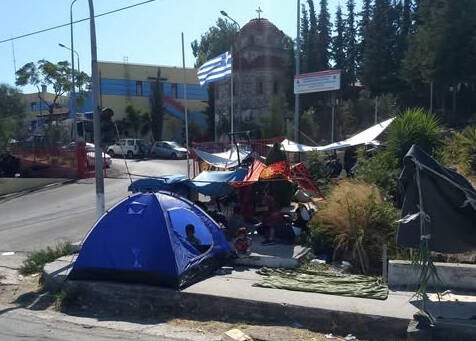

Living on the street
Queuing for food
Before being admitted to Mavrovouni they were screened for coronavirus and roughly two hundred and forty people tested positive and were immediately quarantined - it’s almost certain that Covid had always been present in Moria but went undetected due to limited testing facilities.
During the fire the authorities had lost a lot of their records so before admitting people to the camp they had to produce their I.D., re-register and go through strict security checks. It was also clear that those who went in weren’t coming out again unless there were specific reasons - the facility was to be managed as a closed camp along the lines of a CCAC.
Many people who didn’t want to live in an open prison resisted entering the new camp and there were reports of police actions including roadblocks and tear gas to funnel people towards the entrance - those who refused to enter could not access food distributions but despite this many people continued sleeping outside for several days.
But even if a family did have money they still couldn’t buy shelter or provisions and winter was on its way - so the choice between being cold and wet and having nothing to feed your kids or walking them into Mavrovouni was fairly obvious - and there was mounting pressure from the police and local authorities.
In Samos I had watched friends locked up just for being refugees and now - from my comfortable, warm home in Shropshire - I heard news of thousands being herded into detention for the same “crime”.
By December the camp housed over seven thousand asylum seekers in conditions just as bad as Moria - flooded tents, rudimentary toilet facilities and insufficient, poor quality food. The electricity supply was inadequate and there were regular power outages and occasional electrical fires. The seven thousand included the vulnerable and disabled from the old Pikpa camp that was closed the month after the Moria fire.
Amongst the many restrictions put in place, home-made shelters like the ones found everywhere in Moria were not allowed and cooking fires were banned - all activities were tightly controlled by the police and army and if anything life in Mavrovouni was worse than it had been in Moria. Isolated cases of dysentery were reported in the new camp in December 2020.
It is interesting to reflect that when Ukranians fled to Europe in February 2022 from an attack by Russia (the same country that for years had backed Assad's atrocities against the Syrian people) we didn't treat them like this, on the contrary - all efforts were made to welcome them - I wonder what the difference was?

The early days of Mavrovouni

Locations of soil samples tested for lead contamination

Welcome to your new home
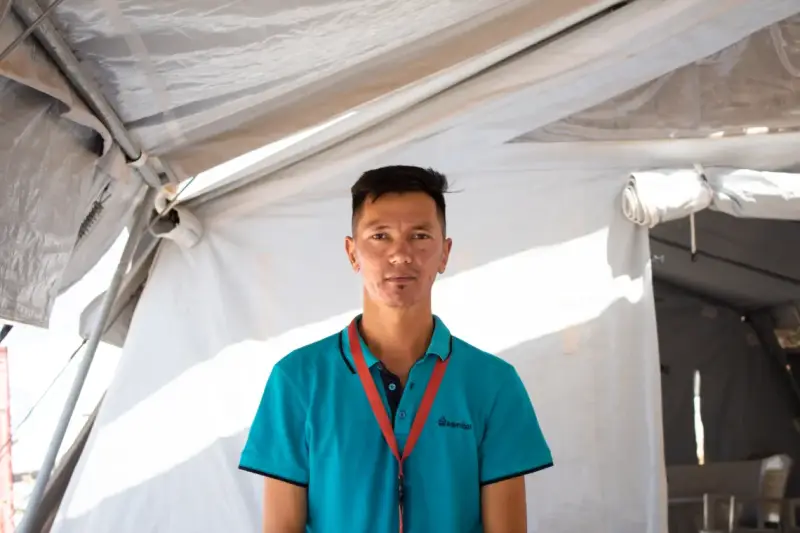
Karam, an Afghan refugee who joined Watershed told UNICEF - “I volunteer because I want to help other refugees, when we arrived in Mavrovouni, we had no water or toilets for an entire month. This happened when Covid was still around, so all we could do was teach personal hygiene to people. Now we have showers and toilets, and people are very happy that they can use them.”
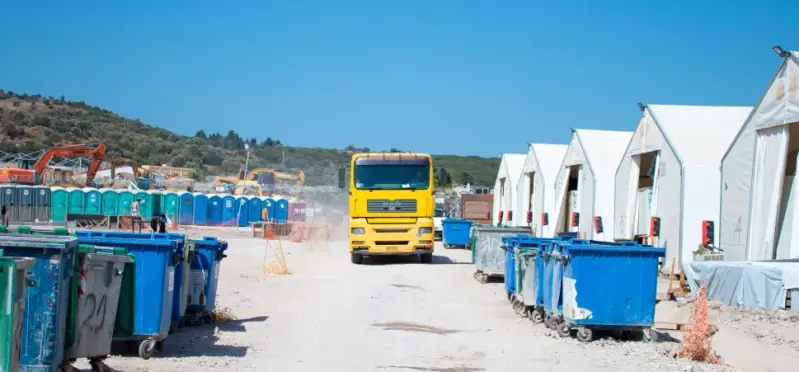
Rubb Halls in Mavrovouni with toilets on the left
Part two
Refoulement
From early March 2020 the refugees were increasingly used as a bargaining chip in EU -Turkey relations and efforts to push them back to Turkey increased.
Many cases were documented of interceptions at sea followed by illegal forced return to Turkish waters. Drifting boats and rafts carrying people were spotted near Turkish territory and in some cases - people who had already reached Greek shores were detained, taken back by the Coast Guard and set adrift in life‑rafts.
The BBC documentary “Dead Calm: Killing in the Med?” broadcast in 2024 investigated these pushbacks by the Greek Coast Guard as well as the sinking of the Adriana just south of the Peloponnese in June 2023 which cost six hundred lives.
The film claims that in 15 separate incidents during 2020/23 as many as forty three migrants died, including nine people reportedly thrown overboard - other (unverified) witness reports record refugees being thrown into the sea with their wrists cable tied together.
One scene from the documentary shows masked men transferring a family including a small child and a baby from a van to a speed boat that took them to a Coast Guard vessel to be taken back to Turkish waters.
These stills show this happening - the full video is on Youtube, go to 32 minutes and 40 minutes into the film to view this incident - Dead Calm: Killing in the Med? | BBC Documentary Full Episode

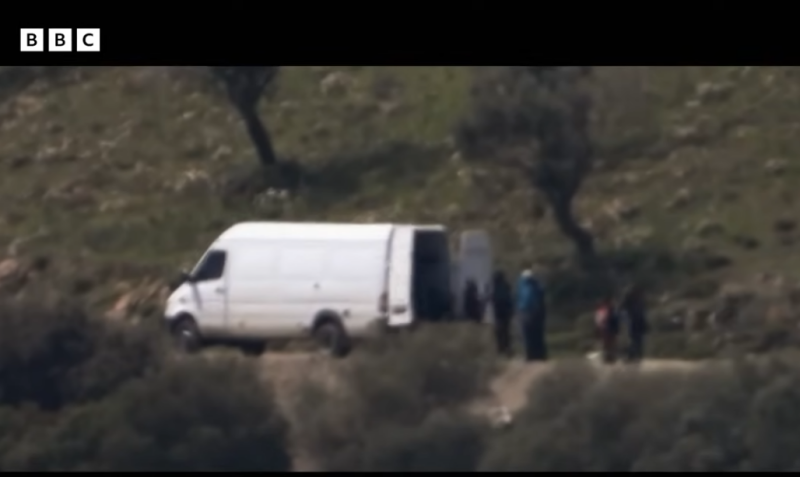
Arriving and being unloaded from the van


The family being taken to the speedboat
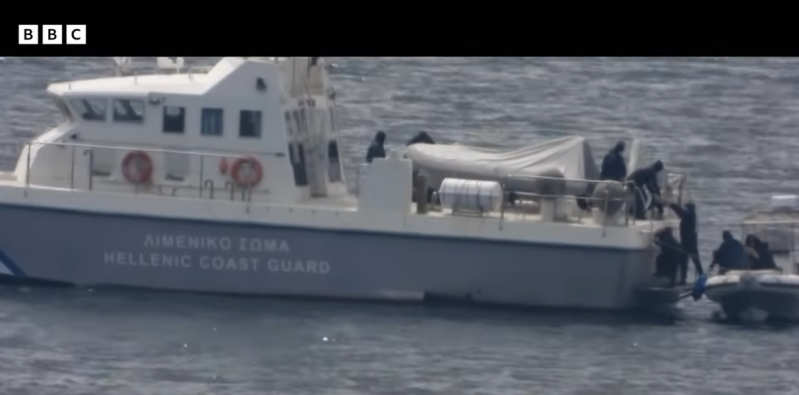
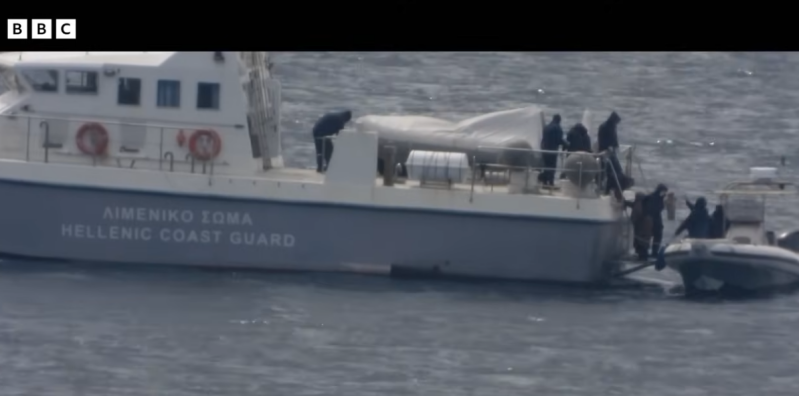
Child being lifted on board
Baby being lifted on board
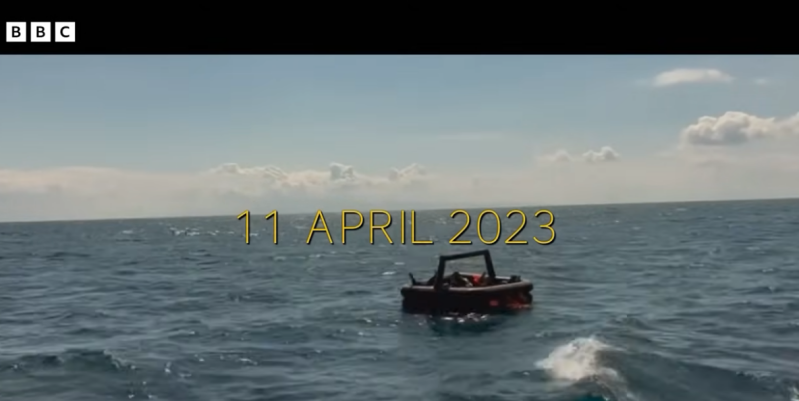
The Turkish Coast Guard film as they approach liferafts and these people were identified as the same family
Any people found like this have obviously been refouled as the refugee boats don't carry liferafts
In February 2020 the total population of refugees on the five Aegean Islands with camps had been 42,000 altogether but by the end of the year this had fallen to 17,000 - reliable figures aren’t available but the number on Lesvos by this time was approximately 10,000 with the most of them in the open prison.
By the end of 2021 there were only 3,500 on the islands in total and again the majority were on Lesvos and in Mavrovouni - there were just under 300 on Samos according to MSF.
Movement restrictions were kept in place at Mavrovouni until June 2022 when most pandemic regulations in Greece were relaxed.
Part three
Some sort of normality
When I visited Lesvos last winter 2024/25 the Mavrovouni camp had evolved and looked relatively comfortable - as refugee camps go. There were sufficient toilets and showers and they were fairly clean - and there was spare capacity for new arrivals in empty Rubb Halls. Each accommodation unit had a reference number in a reasonably easy to follow order and it was possible to find people from their address - so long as they hadn’t been moved in the last few days. The individual units, which were a mixture of tents, Rubb Halls partitioned into small rooms and isoboxes are still cramped though and far below the standard we would normally expect for human beings.
Scabies continues to be a big problem with a high percentage of the people infected - being better than Moria doesn't mean being good, or even adequate. The place isn't as shocking as the old camp but it's still pretty grim - the main improvement is the faster turnaround means it's temporary for the majority of the people.
One of the most worrying aspects of the camp was the detention of the unaccompanied boys who were held in a secure area which they weren't allowed to leave without an escort. They are supposed to be allocated guardians but there aren't enough of them so the children are isolated in overcrowded accommodation with a lack of resources and many remain stuck in these sub-standard conditions for months - with poor hygiene facilities, insufficient support and the associated mental health risks. This is not an acceptable way to look after vulnerable teenage boys.
The local tensions had more or less disappeared and the islanders I know said that the camp was accepted as it was. Very aggressive refoulement continues, though not quite as efficiently as during the pandemic - but still less than half the boats leaving Turkey were reaching the islands.
Prior to the pandemic the only people being fast tracked through the system were unaccompanied minors, children on their own or vulnerable families and now nearly everyone was processed quickly - I met one man who was granted travel documents a month after arriving which would have been unheard of before.
So - by a combination of pushing back and faster processing the population of Mavrovouni is being kept somewhere between two and five thousand. This seems to suit the locals - they get the economic benefit of the camp which provides a lot of employment and supply contracts, the hotels and the usually seasonal apartments are full all year, the bars and restaurants are busy with visiting workers and volunteers and there’s very little trouble or petty crime - the islanders and the refugees coexist as the visitors move through.
Though violent, illegal and largely undocumented pushbacks continue to happen at sea under cover of darkness.
Part four
OHF
One Happy Family started rebuilding after the arson attack which destroyed The School of Peace in March 2020 but while the facilities were ready a few months later the authorities wouldn't let them reopen because of Covid. They were still closed at the time of the September Moria fire so to begin with their volunteers helped the refugees on the streets as best they could - then in October they opened a clothing market and managed to help over a thousand people replace clothes they had lost, despite there being a shortage of donated clothing on the island.
But as people moved into Mavrovouni and with the conditions imposed at the new camp - there was no possibility for visitors to go to the Community Centre.
For a time they organised remote services and distributions but it was clear that as the refugee population on the island was decreasing rapidly OHF would never be busy again. Athens on the other hand was filling up with those processed and transferred to the mainland. Many moved on into Europe but there were lots of people who just couldn’t afford to keep moving.
As 2021 progressed it seemed futile to continue on Lesvos and the Swiss board decided to move the OHF operation to Athens - One Happy Family announced its closure and transfer of activities on the 26th Jan 2022.
After the transfer of so many asylum seekers to Athens there were hundreds sleeping rough around Victoria Square so OHF established the Victoria Centre with onsite partners - but like so many NGOs they eventually ran out of steam - and money. Two years later they withdrew from the Centre and closed the organisation down with this parting message -
“One Happy Family is a mindset, a spirit, a way of working together, a dream and a piece of hope
which is going to live on in so many incredible people living around the world today.”
~~~
This video by MSF from July 2020 gives some idea of what was happening around Victoria Square
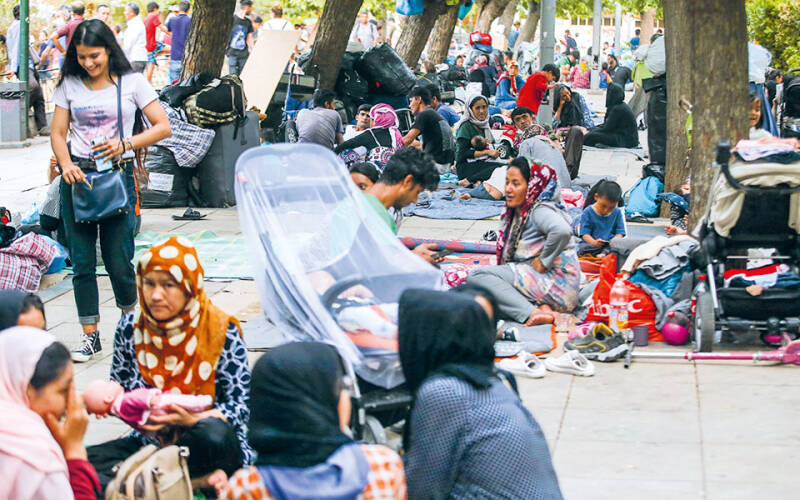
Victoria Square is taking on the characteristics of a permanent dormitory for recognized refugees, as approximately 100 families with children spend the night there every night. No longer having the right to stay in the structures on the islands, as they have been granted refugee status, they arrive in Athens and rush to Victoria Square (photo: INTIME NEWS / STEFANOU STELIOS). - Kathimerini.gr
With the focus in Europe on Ukraine and the population on the islands diminished so was the enthusiasm to support the volunteer groups - donor and compassion fatigue were major factors in the declining interest and many of the NGOs operating at the height of the crisis have now closed.
The Refugee Crisis continues to exist but it has morphed into something new and in the countries that are not in the front line it has become a significant political issue. The situation in the UK gets more distorted and hysterical all the time and the far right is on the rise throughout Europe - though to me - anti migrant and refugee sentiment seems disproportionate to and a distraction from the real issues we face which are driven by greed, inequality and manipulation - but that's a whole other story.
Part five
TLP

The Lava Project continued operating throughout 2020 though not at the same frantic pace as before and we became more reliant on international volunteers as movement for the refugees was restricted and our helpers were being transferred to the mainland.
After the big Moria fire the team did their best to help at Mavrovouni and throughout the pandemic they were busy laundering PPE. They were also taking a small amount of work from OHF as their laundry room had been destroyed in the arson attack of March and from other NGOs - including the Norwegian group Drapen i Havet - A Drop in the Ocean.
The idea behind the name is the same as the Star Thrower story - we are all, the volunteers and the refugees (and everyone else) just individual Drops - but if we can each help one other Drop - we will make a difference.
Rachel stayed with the project for most of 2021 and we were joined by Rebecca who I’d worked with before at OHF and Johanna who I never got to meet, and of course Anastasia worked with us all the way through.
But Akis was needed to help with the OHF move to Athens in early 2022 - so Anastasia would also be moving there soon.

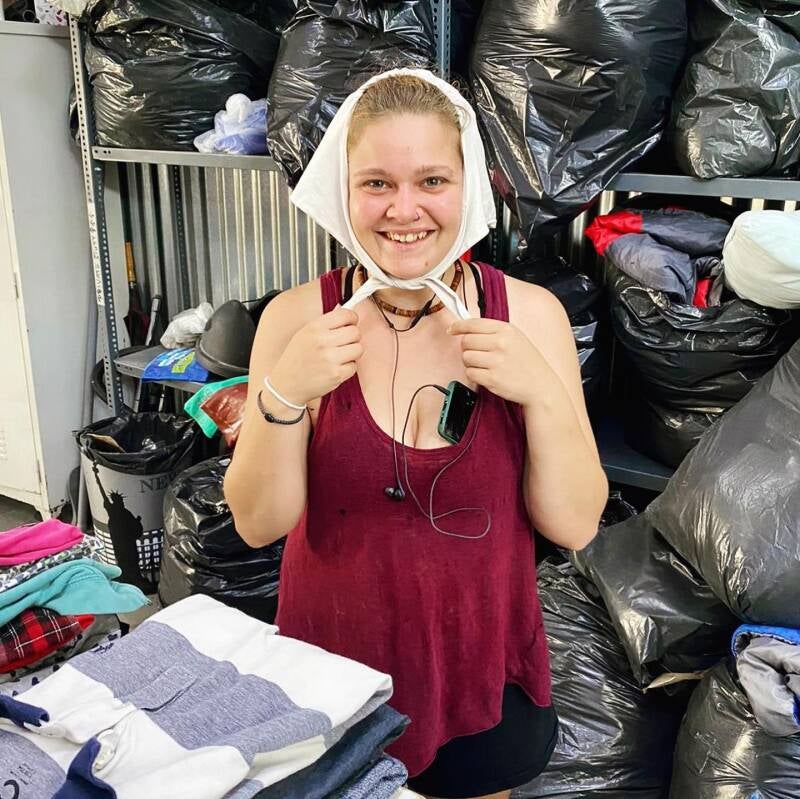
Rebecca and Johanna
With the end of the pandemic came the end of my business and I wasn’t able to return to Lesvos to manage the project. Both my managers had had enough and wanted to retire so we put up two more for sale signs and I had to stay in the UK while we sold up and closed up.

In February 2022 we handed over the keys of The Lava Project to A Drop in the Ocean.
They had been looking for their own laundry premises for some time and it was increasingly difficult for us to keep going - Anastasia was moving to Athens, our financial support was slowly withering away and I couldn’t leave the UK.
The only logical thing was for us to donate the whole operation to A Drop - so that's what we did.
We gave Drapen i Havet all the equipment we had including our small car - the funds left in our Greek bank account had been donated towards our running costs and when we finally paid off all bills, taxes, accountancy fees etc. we passed the balance on to A Drop as well.
The only money left was about £400 in a UK bank account which was where the crowdfunding donations were sent.
Our former Afghan volunteer Raheem, his Pakistani wife Sahira and their children had been in refugee accommodation in Montpelier when they were attacked by another resident who disapproved of their mixed marriage.
I didn’t fully understand all the circumstances but a month later they were living in a tent in a park in the city and when they went shopping one day they returned to find everything they owned had been stolen - including the tent and their bedding - so we sent them the rest of our money and later that year closed our UK Refugee Support bank account.
A Drop in the Ocean kept the machines turning but we were finished - less than four years after starting the project we worked so hard to create.
Part six
A long delayed return
By Easter 2023 we had completed the sale of both businesses in the UK and to celebrate retiring my Romanian rescue dog Bushi and I set off in our thirty year old campervan for a one month holiday to Northern Spain.
While we were away I noticed a lump on my neck and shortly after we returned in June I was diagnosed with cancer.
The brilliant NHS team led by a truly inspirational Indian born ENT Consultant have cured me though the treatment for my type of cancer was pretty dramatic - killing the cancer cells involves almost killing the patient.
I had major surgery in September '23 then started radiation and chemotherapy in November - after they’d taken out most of my teeth in October.
The radiotherapy makes it too painful to eat and I had to feed myself through a tube plumbed into my stomach for two months from the middle of December - about four weeks into that part of the treatment.
For the morbidly curious reader you could watch A Pain in the Neck on C4 -
The Welsh comedian Rhod Gilbert had very similar treatment and his was filmed for a television documentary in support of Stand Up To Cancer
https://www.channel4.com/programmes/rhod-gilbert-a-pain-in-the-neck-for-su2c
By the summer of ‘24 I was recovering well and had my feeding tube removed so was ready to go campervanning again (there’s nothing worse than sharing a campsite shower room with strangers with a rubber pipe hanging out of your stomach) - and by the Autumn was itching to get back to Lesvos.
We loaded the van with donation clothes and Bushi and I set off for Mytiline after the Remembrance Day service on the 10th of November.
Two weeks, three ferries and two thousand miles later - after visiting friends in France, the Amalfi coast and spending two nights in Athens I was finally back in Mytiline.
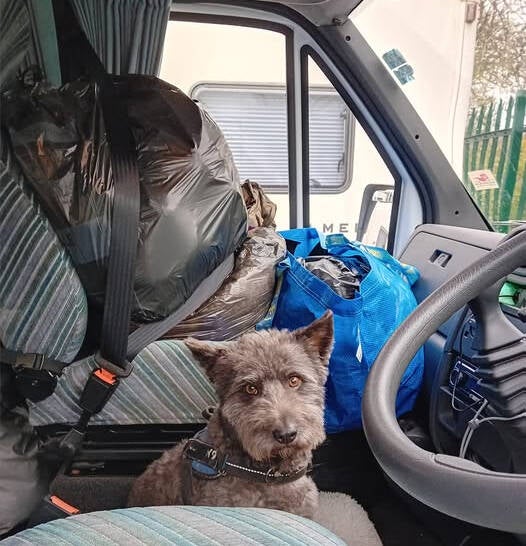

Ready to leave with a van full of children's clothes
Akis, Anastasia, Bushi and Snowy in Athens
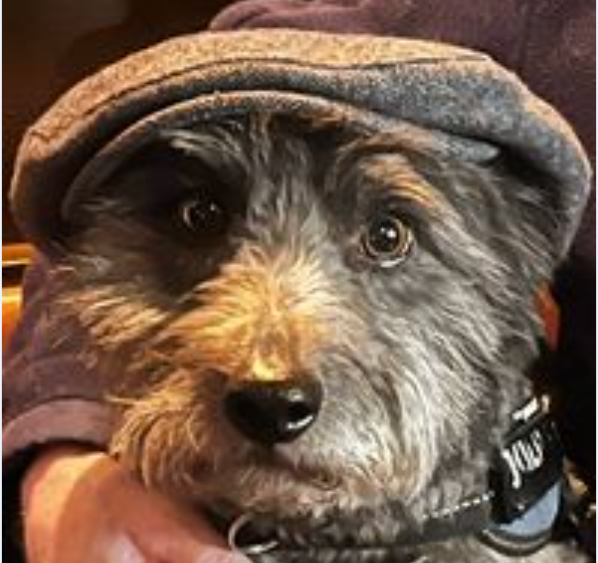
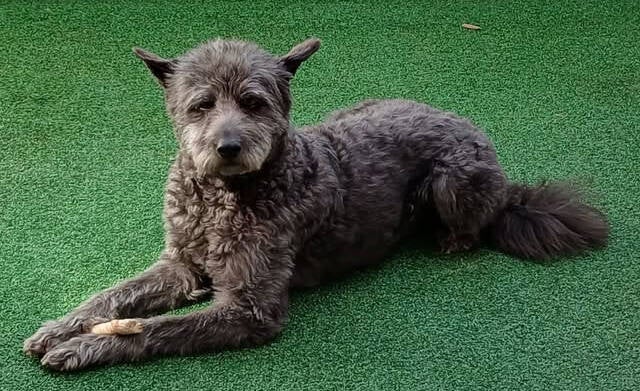
My furry pal and travelling companion - Bushi McBushFace
We volunteered at the old community centre which is now Parea - though most residents of Mavrovouni called it “The Family” - which was ok but of course nothing was the same, it never is when you go back.
Bushi played his part magnificently and was a great hit with the younger visitors and we were often asked if he would pose for photos with refugee children.
The Lava Project premises were empty - Mavrovouni camp management had offered A Drop the use of a building within the camp and they'd moved everything there except the gas dryers.
It felt very sad to be in Mytiline again but I had to go there - it was one of those itches you just have to scratch.

Our original machines were now in Mavrovouni
The most shocking thing for me was visiting the old Moria camp.
The desolation was complete - it was like leaving your home town and returning a year later to find it gone.
After the fire the local Roma community picked the site clean, there was not a single piece of wood or metal left anywhere.
I was wandering through the remains of the Safe Zone, once a temporary home to the hundreds of unaccompanied children who'd passed through the camp, when I noticed a small building I'd never seen before. A tiny orthodox chapel right next to the Zone that had always been obscured by all the cabins when we visited to collect the children's bedding and towels.
As we left an elderly Greek man in a battered old car drove down the hill and stopped just where the leaky toilet block used to be and wound his window down to talk to us - he cast his arm across the view and shook his head muttering over and over "mέγα καταστροφή - méga katastrofí" - it seems we do all speak Greek after all.
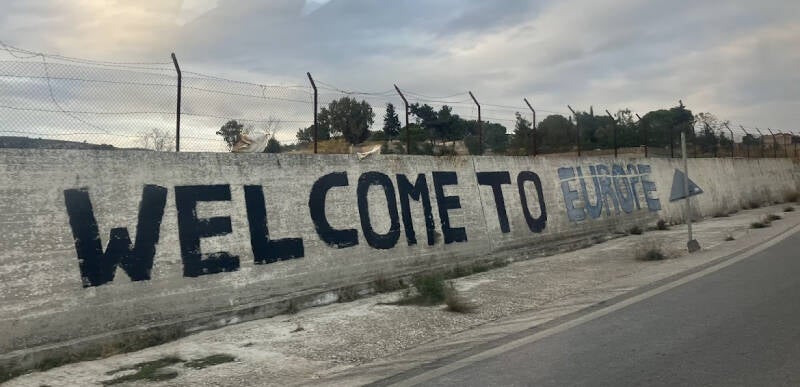

Where the secure detention area was
The main entrance
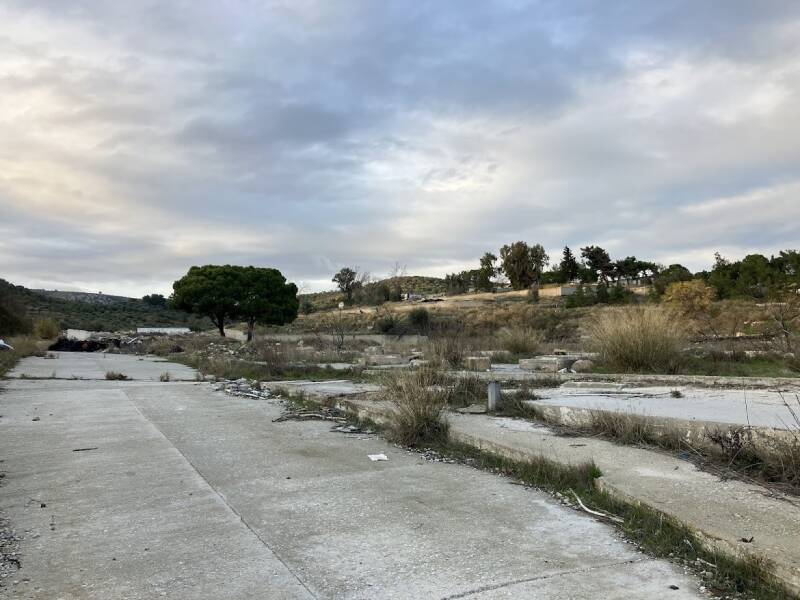
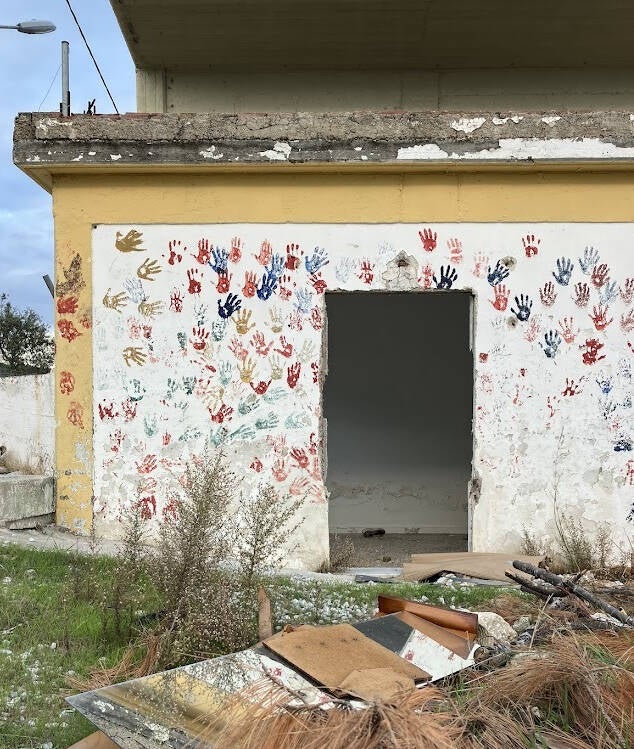
The Protected Area
Safe Zone
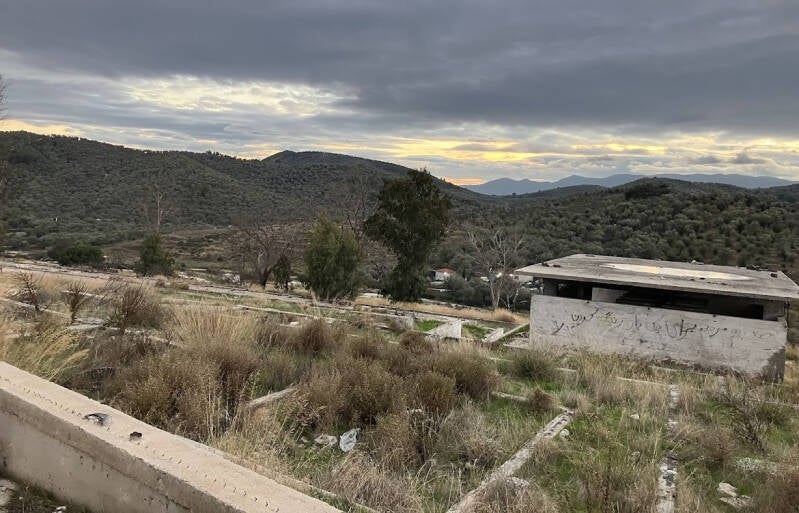
Méga Katastrofí
The community centre of Parea still does good work but a busy day would now involve 300-350 visitors and it felt very quiet. Once again I was the oldest person on the team - but this time there wasn’t anyone even close to my age - the next oldest volunteer was thirty four and by now I was seventy one.
One of the activities was Playstation where we had two screens for the younger visitors to play on - we took it in turns to supervise and needless to say I was useless with any problems and much better at playing chess with them - or serving their tea or coffee.
Amongst the regulars at Parea I naturally had a favourite family - which as usual was because of the children. Almost everyday an Afghan family with three youngsters visited Parea and the oldest girl, who was probably fourteen, relentlessly busied herself with assisting her mother and looking after her younger siblings - like so many of the young refugees she was incredibly resilient, energetic and resourceful and - of course - reminded me of my own girls.
~~~
The speed of processing asylum applications was so much quicker now and some camp residents barely had time to visit the centre as they were busy working on their interviews and getting ready to leave again.
In 2020 a lot of the people were depressed but now they were less despondent - five years later they seemed more optimistic and my overall impression was they were happier.
The speed of movement led to less continuity in relationships with the NGOs and fewer community volunteers, though we didn’t need as many - OHF had a twenty strong security team whereas Parea just needed one person on the gate.
While at the centre I met a young Sudanese man in his early twenties who told me of his journey from Turkey.
He had set off twice in dinghies bound for Samos and they were stopped on both occasions by a large RIB full of armed men dressed in black dry suits with their faces covered who pulled alongside and clubbed people, including the women and children, as they boarded the boat.
The refugees' possessions were thrown into the sea and the outboard motor smashed - along with the hands of the driver. The dinghy was then towed back to Turkish waters and left to drift until they were rescued.
He gave up on Samos and made it to land on his first attempt to get to Lesvos.
The young man was a second year dental student who wanted to finish his training and help his family - who before their civil war had once been well off - I got the impression they’d spent a lot of money to get him this far.
The aggressive refouling and return of people to Turkish waters was recorded by Tommy Olsen of Aegean Boat Report in a Facebook post of 11.12.24 -
“In the end of last week, Turkish coast guard rescued 75 people, from 4 life rafts, found drifting inside Turkish waters in the Aegean Sea, one third of the victims (25) were small children.
The victims claimed that they had first been rescued, deep inside Greek waters, by the Greek coast guard.
Instead of taking them to safety to the nearest port, they transported them towards Turkey, robbed them of all belongings, forced them into life rafts, and left them helplessly drifting in the middle of the sea.”

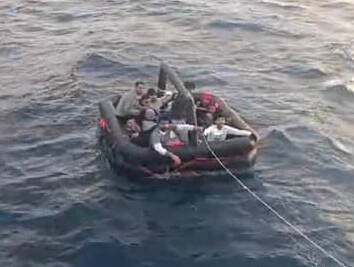

Frontex were certainly very active and one day I counted a dozen vessels in Mytiline - on a visit to Molyvos at the end of December we counted another four Frontex boats in the harbour there.

Frontex vessels in Mytiline - December 2024
Latest reports from Lesvos suggest that the practice of taking people who have already landed back to Turkish waters has ceased - but refouling at sea is still happening.
~~~
Parea were closing over Christmas and New Year as most volunteers were going home for the holiday and there were less volunteers on the island generally - so I looked for something else to do.
The Dutch NGO Because We Carry needed help and we joined them for two weeks.

BWC’s activities are very targeted and they focus mainly on support for pregnant women and mothers with children under a year old and Bushi and I spent a very active Christmas fortnight with them - being really busy and making an impact it finally felt like a proper home coming.
BWC have camp access and over the period Saturday 21st to New Years Eve we made multiple visits to Mavrovouni.

Visiting the camp was very interesting and one of the things I discovered was that among all the different nationalities and languages Turkish was one of the most commonly spoken - obviously a lot of the people had spent a long time in Turkey before reaching Greece.
Despite there being only two full time co ordinators, Sanne and Myrthe and two international volunteers, me and Jasmijn - with the help of a small but amazing team of community volunteers we delivered over a hundred and fifty food parcels each Saturday to the women on our register, we distributed nearly four hundred winter coats plus lots of other items of clothing to recent arrivals and on Xmas Eve handed over fifty five baby strollers that had been collected in Schipol airport and shipped to Lesvos to new mothers in the camp.
Bushi the Dog has his own Facebook page and on 28th December 2024 he let me post this -
"Feeling very humble -
First I’ll explain the food distribution - we pack the bags of food in the garden, they weigh around 3 kilos each, then take them to the camp by van. We work in teams of two with a trolley each with eight bags to a trolley. Today we also gave out a fresh lettuce with each bag. I worked with a Syrian volunteer, Amira, and when we returned to the van after we had delivered our first 32 bags we were joined by a young Sudanese boy (who is a big fan of Bushi’s). We had 17 bags to take to a far away part of the camp and he insisted he tow one of the bag trolleys and I could have the easy job of towing the 17 lettuce!
We gave him a lift home afterwards (to his family's shared isobox in the camp) and he asked where we had got a packet of biscuits he saw in the van. Did we buy them locally? “Yes” said Sanne “from Lidl”. Naturally, I said he should take them home - his reply really took me aback “No” he said “someone else needs them more than me.”
When a thirteen year old boy living in the shittiest situation you can imagine says that you understand what strength and dignity he has. I’ve said it before - l’m constantly amazed at the resilience of the people stuck in these terrible places."
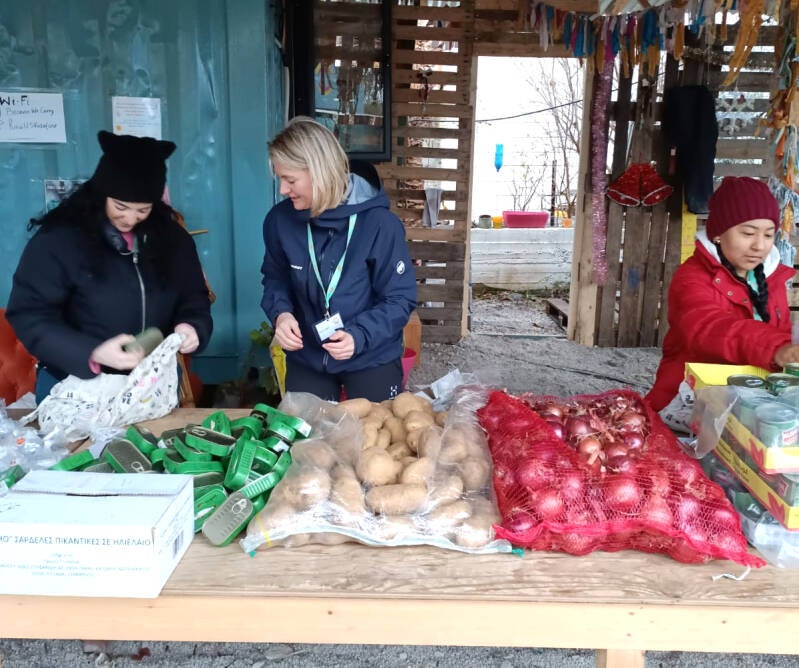


Packing
Contents of a food parcel
Get a move on!


Delivering food parcels in the camp with Amira
A little passenger
Some old fool demonstrating how to unfold a stroller
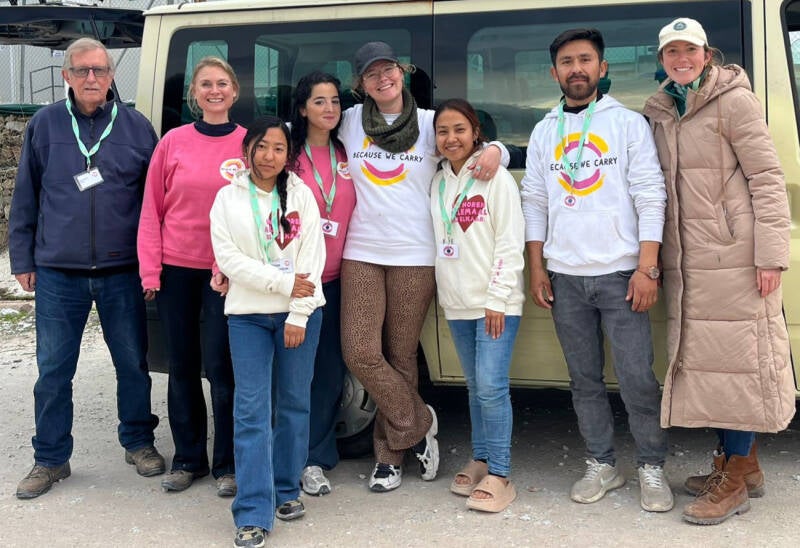
Team Stroller Xmas Eve 2024 - An Old Fool, Jasmijn, Sahar, Sarah, Sanne, Nazanin, Gaffur and Myrthe
After the Xmas holiday I had committed to Parea for a few more weeks but unfortunately the ancient campervan has an ancient gearbox that started behaving badly in the first days of the new year - so we cut short our visit and headed home by the most direct route.
After two ferries, one channel tunnel and driving seventeen hundred miles without third gear we were back in Shropshire by the middle of January.
Working with BWC was very rewarding and I would go again tomorrow if I could - but with Brexit restrictions on time in the EU and having to travel overland with Bushi, which is much more expensive than flying, it seems unlikely I'll be going back - but that itch is still there, so we'll see.
Helping support the people of Vathy, Moria and Mavrovouni was the privilege of my life.